


Introduction
Over the past couple of years and following the rise of political instability and military takeovers, the security dynamics of the Sahel have become a crucible of global geopolitical competition and rivalry. While Western powers such as the United States and France have historically been in the forefront of countering terrorism and insurgency in the Sahel and the wider West African region, there is a growing recognition, if not frustration in recent times over what is seen as limitations of Western support in security provision. The cases of Burkina Faso, Mali, and Niger illustrate the limitations and, in some instances, failures of the Western security model in producing sustainable stability.
Thus, amid spiralling insurgencies, transnational criminal networks, and historic governance deficits, Sahelian states have opened their doors to non-Western security partners. Most notably, Russia has emerged as a prominent security actor, offering military training, equipment, and strategic advisory services. But with influence comes consequences. It is therefore essential to assess the effectiveness of Russia’s security provision to Sahel governments, considering the risks it presents, the opportunities it offers, and what policy pathways might yield better outcomes for regional peace and stability.
Contextualizing Russia’s strategic entry into the Sahel
Russia’s engagement in the Sahel needs to be situated within the context of shifting global power dynamics and growing attraction of the Sahel in the geopolitical and strategic calculations of global powers.
While Western powers historically established themselves as the natural partners in the region based on long historical connections from the colonialism era through the Cold War period and to the global war on terrorism, over time, the West seems to have lost its influence due to a combination of factors, including the widespread disaffection towards Western-backed governments, many of them deemed unable to provide adequate security and effective development outcomes.
These developments have partly resulted in what has been described as the “backsliding of democracy” in the region with the rise into power of military regimes. These developments have produced two opposing emerging dynamics in the form of the weakening or waning of Western influence on the one hand, and the growing influence of new global powers on the other hand.
Russia, has thus, emerged as a key beneficiary of what is generally seen as the growing unpopularity and retreat of the West. The country has, thus, seen an opportunity geopolitically to expand its influence in West and Central Africa in order challenge Western predominance by establishing new diplomatic and economic ties and partnerships.
Strategically, these partnerships facilitate access to natural resources and defence contracts. Thus, for many Sahelian governments, particularly Burkina Faso, Mali, and Niger, Russia represents a powerful alternative to traditional Western partners whose support has been criticized as insufficient or conditional.
Assessing effectiveness of Russian security provision model
Evaluating Russia’s effectiveness in bolstering Sahelian security requires a multi-dimensional analysis of operational results, governance legitimacy, and sustainable impact. Operationally, Russia’s engagement in the region in the short term, has been visible in the form of supply of weapons and in frontline training and security provision using private military contractors like the Wagner Group. These activities may be credited for growing tactical competence in reclaiming territory from insurgents or breaking sieges.
However, these gains are often short-term and isolated. Reports suggest that troop deployments are limited and that coordination with regular Sahelian forces remains weak. In many cases, Russia-aligned elements have been unable to translate battlefield presence into broader territorial control or sustainable improvements in national security architecture. Thus, operational effectiveness is partial, with Russia boosting capacity at the margins but failing to foster enduring operational excellence across Sahelian militaries.
In terms of political legitimacy and governance outcomes, while Russia’s entry into the region represents diversification of global powers providing security support, at the same time Russia’s engagements and partnerships within the region undermines the quest for democratic governance and accountability.
Many Sahelian states hosting Russian forces are themselves under military rule following coups (e.g., Mali and Niger). Thus, Russia’s support for these regimes, often devoid of strict democratic or human-rights conditions, has bolstered authoritarian governance rather than incentivizing political reforms. This dynamic undermines long-term stability.
Security gains that coincide with weakening civil institutions effectively trade democratic accountability for militarized order. This also have the tendency of undermining modest gains at democratic consolidation within the broader West African region where military regimes offering short-term fixes may become attractive. Thus, by aligning with militarized governments without clear democratic benchmarks, Russia’s growing presence and involvement in the regions risk emboldening regimes that might otherwise pursue political reforms, contributing to democratic backsliding across the region.
Other risks include strategic dependency where Sahel governments risk becoming reliant on Russian support without building sustainable domestic capabilities. This dependency raises the spectre of “security neo-colonialism,” and “security-for-access” where strategic autonomy is replaced by external patronage.
The Way Forward: A Constructive Path
Considering the mixed legacy of Russia’s security provision, a more nuanced and sustainable approach is needed. First, it is important for Sahelian governments to establish clear benchmarks and transparency by clarifying the scope, limits, and performance expectations of any foreign security partnership. Agreements must be transparent, independently monitored, and tied to measurable outcomes.
Second, there is the need to strengthen civil-military relations where security provision is accompanied by governance reforms that reinforce accountability and civilian oversight. This prevents militarization from overshadowing democratic development.
Thirdly, there is the need to foster multilateral frameworks by gradually fostering central roles for the African Union and ECOWAS in coordinating security efforts, ensuring that external partnerships complement regional strategies rather than undermine them.
Conclusion
Russia’s engagement in the Sahel in security provision to Sahel governments comes with risks and opportunities. It has delivered tactical military support that, in some instances, has produced localized gains.
The entry of Russia and any other new actor to the region also helps to diversify partnerships and ensures that no single global power dominates and imposes its priorities and ideals. Yet, the unprincipled embrace of undemocratic and authoritarian traits of global powers such as Russia also risks deepening governance challenges, strained regional cooperation, and introduced pernicious human-rights challenges.
The effectiveness of such engagement cannot be judged solely on battlefield outcomes; it must be assessed against the yardsticks of sustainable peace, accountable governance, and regional resilience.
For the Sahel to chart a secure and sovereign future, its governments must wield external partnerships judicious by demanding transparency, reinforcing democratic norms, and building indigenous capacities that outlast any foreign actor. The way forward is not to reject cooperation outright but to demand partnerships that strengthen, rather than weaken, the foundations of peace and security across the West African region generally.
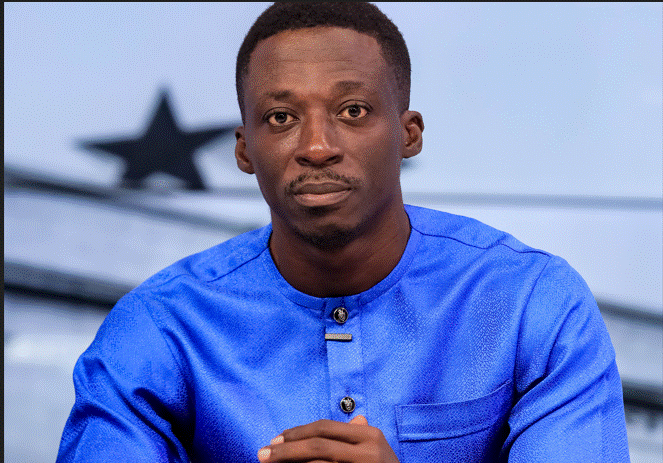
By Lord Mawuko-Yevugah, PhD
Associate Professor of International Relations and political economy at the Ghana Institute of Management and Public Administration (GIMPA); and Director of Centre for African Diplomacy and Global Engagement (Afro-global)
The post Assessing the effectiveness of Russia’s security provision to Sahel governments: risks, opportunities and the way forward appeared first on The Ghanaian Chronicle.
Read Full Story





Facebook
Twitter
Pinterest
Instagram
Google+
YouTube
LinkedIn
RSS