


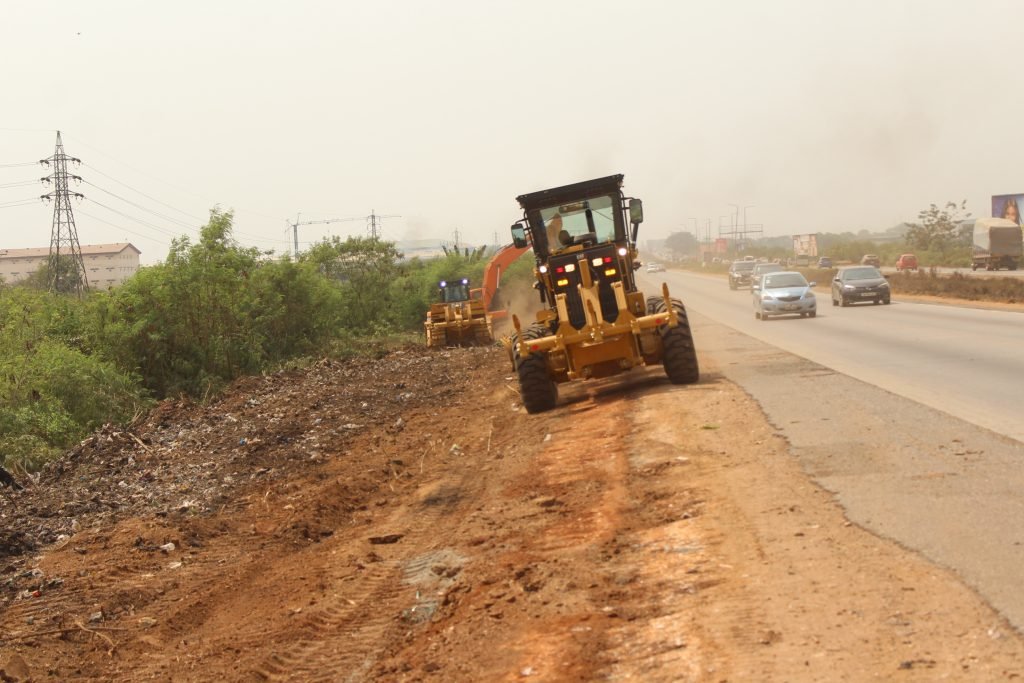
The Tema Motorway expansion project, now 35 per cent complete, is a reminder that Ghana’s infrastructure ambitions often collide with hard fiscal realities and everyday human inconvenience. As reconstruction progresses on this critical economic corridor linking Accra to the Tema Port, the country finds itself at a familiar crossroads: balancing long-term national interest with the short-term burden placed on commuters, residents and businesses.
There is no disputing the necessity of the project. Built in 1965 for a vastly smaller population and vehicle volume, the Tema Motorway has long outlived its original design capacity. What was once a limited-access highway has become a heavily congested urban artery, strained by rapid urbanisation, uncontrolled access points and the relentless movement of heavy-duty trucks serving the port.
The Ghanaian Times, therefore, regards the expansion as not a luxury but overdue maintenance of a national economic lifeline. In that sense, the scale and ambition of the current project deserve commendation. A 10-lane divided highway with dedicated express lanes, multiple interchanges and pedestrian footbridges represents a bold attempt to future-proof the corridor.
That the project is being undertaken under a Public-Private Partnership by a wholly Ghanaian-owned firm also speaks to growing local capacity in delivering complex infrastructure. If completed as designed, the motorway could significantly improve traffic flow, safety and logistics efficiency, with positive ripple effects for trade and economic growth.
However, progress at 35 per cent after funding-related slowdowns raises important questions. Infrastructure projects of this magnitude demand financial certainty, yet Ghana continues to embark on critical works without secure, full-cycle funding. The result is predictable: delays, cost pressures and prolonged disruption to public life.
While phased financing may be unavoidable given current economic constraints, it exposes a broader structural weakness in infrastructure planning that successive governments have failed to fully address.
For commuters and residents along the corridor, the expansion has come at a steep cost. Frequent diversions, traffic snarls, dust, noise and restricted access have turned daily routines into exercises in patience. Transport operators face rising fuel costs and passenger frustration, while roadside traders report declining patronage.
These are not minor inconveniences; they translate into lost income, stress and reduced quality of life. Public support for major infrastructure projects is easily eroded when the burden appears unevenly shared.
The Ghanaian Times welcomes the contractor’s efforts to mitigate these impacts, including watering dusty sections, asphalting critical stretches and improving traffic management. However, these measures must be consistently enforced and transparently monitored.
We also remind road users that they have responsibilities. Illegal U-turns, disregard for signage and the practice of bribing impostors posing as road workers worsen congestion and compromise safety. Clear communication and visible on-ground coordination remain essential to sustaining public trust during construction.
More fundamentally, the Tema Motorway experience underscores Ghana’s chronic challenge of playing catch-up with urban growth. Population expansion, rising vehicle ownership and sprawling settlements have repeatedly outpaced infrastructure development.
In our view, therefore, the motorway’s prolonged overstretch is not merely a technical failure but a planning one. Without stronger land-use controls, integrated transport planning and long-term financing models, today’s expanded motorway risks becoming tomorrow’s bottleneck.
As work continues, government and project managers must treat public engagement as a core component of delivery, not an afterthought. Regular updates, realistic timelines and responsiveness to community concerns can go a long way in sustaining patience. Delays caused by funding gaps should be openly acknowledged, not quietly absorbed into revised schedules.
The discomfort currently endured by road users may indeed be temporary, but public confidence is fragile. The Tema Motorway expansion must not only be completed; it must be completed efficiently, transparently and with lessons learned.
Ghana cannot afford a future where critical infrastructure is always catching up, always underfunded and always disruptive. This project should mark a turning point from reactive expansion to proactive, well-financed urban planning.
Follow Ghanaian Times WhatsApp Channel today. https://whatsapp.com/channel/0029VbAjG7g3gvWajUAEX12Q
Trusted News. Real Stories. Anytime, Anywhere.
Join our WhatsApp Channel now! https://whatsapp.com/channel/0029VbAjG7g3gvWajUAEX12Q
The post Tema Motorway Expansion: A Necessary Pain That Must Be Better Managed appeared first on Ghanaian Times.
Read Full Story





Facebook
Twitter
Pinterest
Instagram
Google+
YouTube
LinkedIn
RSS