
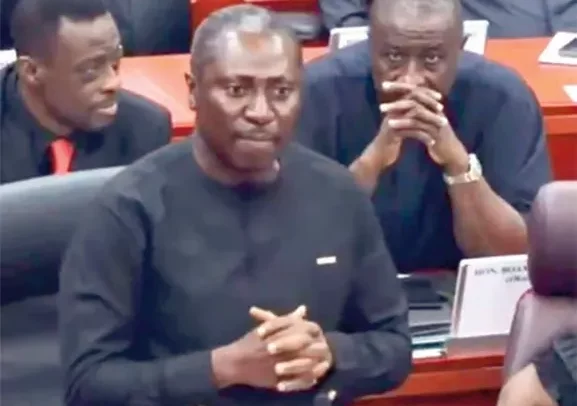

Alexander Afenyo-Markin
The Minority in Parliament has challenged the government’s claim of improved fiscal performance, arguing that the stronger fiscal position reported in the 2026 Mid-Year Budget Review was achieved largely through expenditure cuts rather than genuine economic gains.
Responding to the Mid-Year Budget Review presented by the Finance Minister, Dr. Cassiel Ato Forson, the Minority Leader, Alexander Afenyo-Markin, accused the government of withholding funds from ministries, departments and agencies while portraying the resulting fiscal surplus as evidence of prudent economic management.
According to him, the Finance Minister’s assertion that “the true character of a finance minister is not determined by how much he spends” amounted to an admission that the government was deliberately restricting expenditure.
“Such a statement must cause palpitations among ministers of state,” Mr. Afenyo-Markin told the House, and added, “Basically, what he is telling all ministers is that he is not going to spend; he is not going to release funds to you.”
The Effutu Member of Parliament (MP) argued that the improved fiscal balances highlighted by the Finance Minister were not the result of increased revenue mobilisation or stronger economic activity but rather the consequence of severe spending restraint across government.
He contended that many ministries had become ineffective because they lacked adequate budgetary releases to implement programmes and projects approved by Parliament.
Mr. Afenyo-Markin also questioned discrepancies in the government figures relating to releases to the agriculture sector.
He noted that while the Deputy Minister of Finance, Thomas Nyarko Ampem, had previously indicated that GH¢1.6 billion had been released to the Ministry of Food and Agriculture, the Finance Minister had now reported a figure of GH¢1.1 billion.
The Minority Leader said the inconsistency raised concerns about transparency and accountability in the government expenditure reporting.
Beyond the fiscal figures, he criticised the Mid-Year Budget Review for failing to provide new policy interventions for the cocoa sector, which remains a major contributor to the national economy.
He lamented the plight of cocoa farmers and accused the government of neglecting the sector.
“Throughout his review, there was no policy announcement for the cocoa sector. The four million cocoa farmers are suffering,” he stated.
Mr. Afenyo-Markin further blamed the government for losses associated with the Gold-for-Reserves programme, arguing that earlier warnings from the Minority regarding the policy had been ignored.
According to him, the government proceeded with the programme despite concerns over the costs involved and only adjusted the policy after intervention by the International Monetary Fund (IMF).
He alleged that the country had already incurred losses amounting to GH¢9.6 billion as a result.
The Minority Leader described the Mid-Year Budget Review as “full of English with empty payment,” insisting that the government had failed to provide adequate details about payments it claimed to have made.
He accused the administration of favouring party loyalists in the disbursement of public funds while ordinary Ghanaians continued to face economic hardship.
A major point of contention during his presentation was the government’s flagship 24-Hour Economy initiative.
Mr. Afenyo-Markin questioned the decision to allocate GH¢42 million to the implementation of the 24-Hour Market programme while many Agenda 111 Hospital projects remained incomplete.
He argued that health infrastructure should have been prioritised over market construction.
“When there are no hospitals, how do you say you are constructing markets?” he asked.
The Minority Leader further alleged that the government was using allocations meant for Metropolitan, Municipal and District Assemblies to finance aspects of the 24-Hour Economy programme.
He also criticised the administration for failing to provide alternative industrialisation policies after discontinuing the One District One Factory (1D1F) initiative introduced by the previous New Patriotic Party (NPP) government.
According to him, businesses had lost confidence in the government’s economic direction, while rising electricity tariffs were undermining efforts to promote round-the-clock economic activity.
He maintained that many young people had lost their jobs under the current administration and accused the government of failing to create meaningful employment opportunities.
By Ernest Kofi Adu, Parliament House
Read Full Story



.jpg)


Facebook
Twitter
Pinterest
Instagram
Google+
YouTube
LinkedIn
RSS