


Ghana does not rush you. It waits. It observes. And before you realise it, it has quietly enveloped your sense of time, people and purpose. For Mrs. Nimeesha Gupta, wife of H.E. Mr. Manish Gupta, High Commissioner of India to Ghana, what began as a diplomatic posting slowly became something far more intimate: a lively education in community, resilience and human connection. Akwaaba was not just a greeting; it was a philosophy. And long before she noticed it, Ghana had begun to write itself into her life.
Woven Strands — her poetry collection — grew out of post-it notes, photographs and half-formed thoughts scribbled between errands and engagements. But this was never about merely documenting places. It was about understanding what staying long enough does to you.
From the bubbly streets of Accra’s roads to the quiet dignity of elders, from the humour tucked into everyday struggle to the unspoken rule that no one walks alone, Ghana offered lessons that refused to stay theoretical.
Between red dust and ocean wind,
I found my name in another tongue.
There is an Indian phrase, vasudhaiva kutumbakam, the world is one family. In Ghana, that idea lives comfortably alongside “By God’s Grace” and “Yes, please,” where kinship expands beyond blood and belonging is a choice.
Below, together with the B&FT’s Ebenezer Chike Adjei Njoku, they trace how poetry became a form of gratitude, how a diplomat’s spouse becomes soft power in human form, and how culture is best understood not from balconies, but from conversations at fruit stalls and roadside benches.
Woven Strands is, ultimately, a love letter, not loud, not sentimental, but deeply felt. And Ghana, it seems, read it first.
B&FT: Your book reflects deeply on your time in Ghana. What first prompted you to put these experiences into writing?
NG: My book Woven Strands explores Ghana’s rich cultural landscape, showcasing its diverse people, art, and traditions. The collection includes poems that honour the incredible strength and resilience of women while celebrating the beauty of life and nature in all its many forms.
Woven Strands resonates with cultures and communities around the world, reflecting our existence in a global village by weaving the ‘strands’ that symbolise lineage, family ties, history between people and generations and finally skillfully braiding together multiple ideas to form a tapestry of shared experiences.
Talking about my self-reflection of this beautiful country, Ghana, the vibrant rhythm of the country greeted me with a warm ‘Akwaaba’, and I found myself immersed in a sensory overload of experiences. I encountered bustling markets, colourful fabrics, neon lights at night, the clattering of tro-tros, the red dust on the roads, the sound of waves crashing on the shore, and the scarlet sunset behind the trees. Inspired by this, I felt compelled to appreciate the cultural landscape of Accra and write my thoughts.
B&FT: At what point during your stay did you realise this was becoming more than just personal notes or reflections?
NG: After about a year of living in Ghana and exploring various regions, I looked back at my post and the pictures I had taken along the way. I realised that this journal was not just a record of ‘what I did’; rather, it was about ‘what Ghana did to me.’ It had transformed me from a mere diarist into a storyteller.
B&FT: Have you always had a knack for writing, or did this book mark a new creative chapter for you?
NG: I have always enjoyed writing poetry, mainly focusing on my personal memories of childhood, family, festivals, nature, and the abstract concepts of life. ‘Woven Strands’ explores the connections among individuals, art, culture, and traditions, highlighting how these elements intertwine in the fabric of society. It is a creative endeavour to give back to the community that has given me a place in its heart.
B&FT: Did your professional or educational background influence the way you approached the book?
NG: As an educator, I have developed a passion for learning, which encourages me to explore the ‘why’ behind the ‘what’. Instead of simply seeing a wooden mask, I delve into its history and the craftsmanship involved in its creation.
Additionally, living a diplomatic life has prompted me to seek common values across diverse cultures, allowing me to relate and connect these various aspects to the Indian context as well.
B&FT: If you had to describe Ghana in three words after living here, what would they be, and why?
NG: If I had to describe Ghana in three words, I would choose Resilience, Relational and Rhythmic. Despite significant economic challenges, Ghanaians demonstrate an unshakable spirit and an ability to find a way forward with a smile. Family values are strong in Ghana, and interactions often begin with a greeting or a smile. People care about each other and are forever ready to offer help. The phrase “Yes, please” is commonly used either in acceptance or polite denial. The pace of life, the energy in the atmosphere, and the flow of daily activities create a rhythm that resembles a musical composition, full of both high and low notes.
B&FT: Which aspects of Ghanaian culture resonated most deeply with you?
NG: Ghanaians have a deep respect for their elders and ancestry, and they maintain strong connections to their past. The chiefs are regarded with high esteem, and family lineage plays an important role.
The history of Adinkra symbols is quite intriguing. More than just beautiful designs, they are a visual language representing complex philosophical concepts. For example, Gye Nyame represents the supremacy of God; it reflects a deep-rooted spirituality that permeates daily life.
The concept of ‘Akwaaba’ is not just a ‘welcome’ sign at the airport; it’s a cultural DNA. There are strong community bonds and respect for elders.
Ghanaian culture has a remarkable way of using humour and creativity to navigate challenges. Communication is often peppered with proverbs, making even a simple conversation feel like an art form.
With the ‘Ghanaian Spirit’ of ‘can-do’, there is a persistent thread of energy and pride.
Whether it’s the vibrant Kente weaving (where every colour has a specific meaning) or the elaborate funeral celebrations, life in Ghana is treated as a series of meaningful transitions.
This deep-rooted connection cultivates a sense of belonging that is increasingly rare in today’s world, highlighting the value of community and heritage.
B&FT: Were there any customs or social rhythms you initially found unfamiliar but later came to appreciate?
NG: I found the tradition of celebrating funerals with music, dance, food, and individuals dressed in formal attire to be particularly interesting to observe. This rich cultural practice highlighted the depth of community bonds and the celebration of life, even in moments of grief.
The culture of saying “yes” to everything implies that “I will try” or “By God’s Grace.” I appreciated the fact that they made an effort, even if things did not always go as planned. I also learned about ‘Ghanaian time’, where events rarely start on schedule. Eventually, I grew accustomed to this, realising that their presence was often more important than the timing.
Life as a diplomat’s wife
B&FT: How would you describe the role of a diplomat’s spouse, particularly in a posting like Ghana?
NG: In a context like Ghana, the spouse embodies a powerful form of ‘soft power’, engaging with the community as an informal cultural navigator. This vital role nurtures meaningful bonds and fosters people-to-people bonds and linkages, creating a cultural bridge between the two countries.
Moving to Ghana involves a steep learning curve. The spouse often becomes the CEO of the household. Learning about the best spots in the city, managing household staff, and the local healthcare system for the family usually falls on the spouse’s shoulders.
ASOHOM, NAWA and other similar expat groups in Ghana are very active. Spouses often lead these groups, providing the social glue that keeps the diplomatic community sane and connected.
In Ghana, a diplomat’s spouse is a cultural entrepreneur. We are creating a life from scratch in a vibrant, sometimes chaotic, but deeply rewarding environment. We are always representing your country, even when just buying groceries or enjoying the arts market.
B&FT: What are the unseen or often misunderstood aspects of that role?
NG: Many people view this role as exciting, filled with lavish dinners and meetings with celebrities, but the reality is often much more demanding. The constant need to rebuild a home every three years can be incredibly taxing, especially when you are unfamiliar with the language or the systems of the country.
We often follow our spouses’ careers, sometimes sacrificing our own professional paths, which can lead to feelings of worthlessness. Additionally, we may find it challenging to exercise our personal choices. It is crucial to remain vigilant and poised, as we are seen as representatives of our country.
In the end, I would say that the diplomat represents the country’s interests; the spouse represents the country’s heart.
B&FT: How did you navigate maintaining your own identity while supporting a demanding diplomatic career?
NG: I navigated this by carving out my own niche for my passions. Writing this book ‘Woven Strands’ has been an immensely rewarding and fulfilling endeavour.
Our active and vibrant diplomatic spouses’ group, ASOHOM, organises outdoor excursions, exhibitions, lunches, and engaging charity and fundraising events that foster connection and community.
Additionally, I actively participated in groups like the Breakfast Club and the Walk and Talk Club, which welcome both Ghanaians and expatriates. I deliberately sought out friendships and pursued hobbies such as art classes, bead workshops, and batik printing – activities that not only enriched my life, but also allowed me to interact with the local artists and kept me deeply engaged and purposefully occupied outside of my diplomatic responsibilities.
B&FT: Were there particular places in Ghana that became personally meaningful to you?
NG: In Accra, twice a week, I eagerly ventured to the fruit stall near my home, where the vibrant displays of avocado, mango, and papaya never failed to brighten my day. Strolling along Palm Beach, enjoying the sunset, searching for gifts at the souvenir shops and Accra Art Centre, or TettehQuarshie market, getting my travel photos printed and enjoying my conversation at the printshop, or selecting exquisite African fabric and shirts from Woodin.
Visiting Aburi Gardens helped me to recharge and escape the heat and the hustle and bustle of Accra. The air is noticeably cooler, and the century-old palm-lined paths provide the perfect backdrop for soaking in nature.
My trip to the breathtaking Volta region was unforgettable, with the scenic cruise on the Volta River standing out as my adventure. Climbing Afadjato, the highest peak in the region, was a thrilling achievement, while the majestic Wli Waterfalls offered a serene escape, punctuated by the astonishing sight of fruit bats in their natural habitat. Interacting with the playful monkeys in Tafi Atome was a heartwarming highlight, infusing my journey with a sense of wonder.
Furthermore, the captivating visits to the historic Elmina and Cape Coast castles deepened my appreciation for Ghana’s rich heritage and reminded me of the gravity of history and the resilience of the Ghanaian spirit, giving a spiritual experience.
These places become meaningful because they offer a ‘third space’ — they are not the Embassy, and they aren’t your home. They are where you and Ghana finally meet in the middle.
B&FT: How did interactions with ordinary Ghanaians influence the tone and content of your book?
NG: Conversations with my house staff, street vendors, and owners of fresh fruit and vegetable stalls provided excellent opportunities to hear captivating stories. I would ask them about their families, their health, the weather, traffic conditions, or sometimes politics.
These interactions taught me about the pulse of the country and its resilient ‘can-do’ attitude. I wanted the readers of my poems to hear the voices of the people I met, rather than just my interpretation of their experiences.
The book became a tribute to the people who actually make the country run. It is their hospitality and wit that provide the ‘heartbeat’ of the story, making it a reflection of the Ghana they live in every day.
B&FT: What did Ghana teach you about community and belonging?
NG: Ghana welcomes everyone with open arms. I came as an observer, but I left feeling like part of the family. In Ghana, you are never truly alone; there’s always a neighbour nearby who cares and is ready to check on your well-being.
Just show genuine love and respect for the local traditions, and you will experience the true spirit of this incredible country.
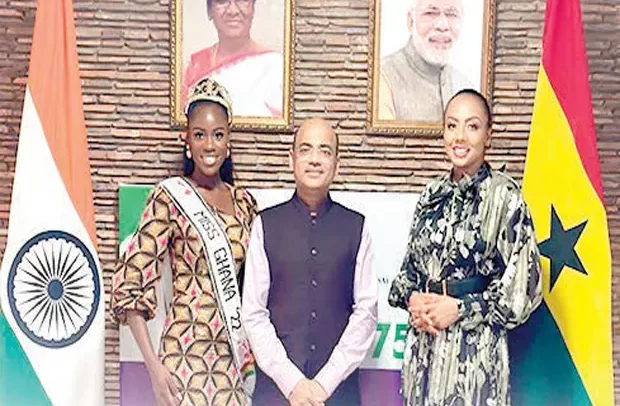
[L-R] Mrs. Nimeesha Gupta, wife of the Indian High Commissioner to Ghana; H.E. Mr. Manish Gupta,
Indian High Commissioner to Ghana; Mr. Sam George, Minister of Communications, Digital Technology and Innovations; Mrs. Abla Dzifa Gomashie, Minister for Tourism, Culture and Creative Arts; Mr. Mohammed Adams Sukparu, Dep. Minister of Communications, Digital Technology and Innovations; Mr. Abdul-Rashid Pelpuo, Minister for Labour, Jobs and Employment, Mr. James Gunu, Volta Regional Minister
Indian High Commissioner to Ghana; Mr. Sam George, Minister of Communications, Digital Technology and Innovations; Mrs. Abla Dzifa Gomashie, Minister for Tourism, Culture and Creative Arts; Mr. Mohammed Adams Sukparu, Dep. Minister of Communications, Digital Technology and Innovations; Mr. Abdul-Rashid Pelpuo, Minister for Labour, Jobs and Employment, Mr. James Gunu, Volta Regional Minister
The Ghanaian use of ‘Mum’, ‘Brother’, ‘Sister’, ‘Auntie’, for non-relatives is not just a way to address; it’s like an expansion of the family unit. It taught me that community is a choice, and this was incredibly healing for someone living far from home and family.
Ghana taught me that belonging is not about fitting in; it’s about showing up for others so they feel seen.
Reflections and insights
B&FT: What lessons from Ghana do you think will stay with you long after you leave?
NG: The most enduring lesson is that “human connections are powerful.” A day spent building relationships is never wasted; it adds meaning and purpose to life and, most importantly, makes you feel truly human.
Ghana has taught me to be happy and content with what I have. There is a phrase in Ghana, ‘Ways and Means’, which refers to the incredible resourcefulness people use to solve problems. When you see your Ghanaian friends navigate immense challenges with a smile, saying “God will provide,” or “By God’s Grace”, your own little problems lose their sting. This mindset is not a sign of complacency; rather, it provides the strength to handle situations in a better way. The way the elderly are revered and the ancestors are remembered, gives a sense of weight and meaning to everyday existence. You start respecting the older generation in your family and realise that ‘new’ is not always ‘better’.
B&FT: Has your time here changed the way you view Africa more broadly?
NG: My time in Ghana did not just change my view of a country; it acted as a corrective lens for an entire continent’s narrative. When you live here, you realise that ‘Africa’ is not just a set of 54 countries with safari and ancient rituals; the reality is that it is vibrant, modern, and intellectually rigorous.
My experience here has profoundly transformed my perspective by highlighting the extraordinary diversity within a single country. If Ghana alone boasts such a rich tapestry of languages, histories, and traditions, then the idea of ‘Africa’ as a unified concept becomes incredibly complex and multifaceted.
In Ghana, I witnessed how development and innovation harmoniously coexist with the preservation of cultural traditions and historical legacies. This vibrant nation has revealed a continent that is not merely catching up with the rest of the world but is boldly setting the pace for global progress.
B&FT: Were there moments that challenged your assumptions or expanded your worldview?
NG: In many ways, living in Ghana is a process of unlearning. Coming from a consumer-driven culture, you see the absence as a lack of commitment and not a challenge. I visited a small village where families lived in mud-brick homes with basic amenities, or lived in stilt houses cut off from the mainland. My first instinct was one of pity.
I quickly realised that these communities often possessed a level of emotional and social security that we lack in our world.. Their ‘wealth’ was in their relationships – eating and grieving together, and no one was ‘invisible’. It forced me to redefine the concept of what a ‘successful’ society looks like: a society with a High Happiness Index.
Wealth is not about owning material possessions; rather, true richness lies in maintaining strong family connections, supporting one another, and enjoying peace of mind at the end of the day. These individuals are the real millionaires.
B&FT: As you turn the page on Ghana, what does the next chapter look like for you personally?
NG: Turning the page on Ghana is a bittersweet transition. In the world of diplomacy, we often talk about ‘leaving a post’, but when it comes to Ghana, it feels more like leaving a piece of your renovated self behind. Living in Ghana has provided me with an invaluable set of skills called Cultural Intelligence (CQ).
I want others to know that Africa is not just a destination for safari but a vibrant ecosystem of culture, innovation and knowledge to be joined.
I will try to maintain the ‘Bridge’ between Ghana and the new destination. I’ll try to stay connected to the local NGOs and artisans I met and will let the world know of the ‘Akwaaba Spirit’ where each guest is a blessing and each human connection matters.
We are embarking on an exciting journey to a new destination: Ireland. Though it may be cold and windy, I carry with me the vibrant warmth of Ghana. My goal is to be fully present, to slow down, and to truly connect with the people and community that I am about to embrace as my own. This move symbolises a fresh start, and I am committed to cultivating meaningful relationships and a sense of belonging in this new chapter of my life.
B&FT: Do you see yourself continuing to write, perhaps documenting other postings or themes?
NG: This poetry book has opened new horizons. I will continue to weave human stories and explore the connections that unite diverse worlds. We do not just ‘move on’ from places like Ghana; we move forward with them. I hope and believe that my words can move and connect the world by showcasing the cultural landscape of two countries.
B&FT: What advice would you give to spouses preparing for their first diplomatic posting abroad?
NG: If I had to give three suggestions, I would say –
You are not just a trailing spouse – you could be an artist, an adventurer, or an amateur poet like me. Always pursue your passions and follow your creative endeavours.
Find comfort in the uncomfortable and say ‘Yes’ to invitations that involve learning. Lean into the unfamiliar, as that is where the real growth happens. You might not have a prosperous career or earnings, but your life is a map of incredible adaptability, cultural intelligence, and priceless experiences. You have earned a Master’s in Humanity.
B&FT: How would you like Ghanaians to feel when they read your book?
NG: When Ghanaians read my poems, I want them to feel seen and respected. I want them to feel validated and proud. I want my Ghanaian friends to see their reflections on the pages and recognise the wit, complexity, and dignity of their daily lives.
If a Ghanaian reader finishes my poem and says, “Yes, that felt so real,” it would be my greatest reward. I want them to feel that their culture was not just ‘consumed’ by a diplomat’s spouse, but that it was engaged with honesty. I want a Ghanaian reader to read my poems and say to me: “You are one of us now.”
B&FT: If one takeaway about Ghana could stay with readers, what would you hope it would be?
NG: If readers take away only one thing, it should be that the most essential element in the world is human connection. In an increasingly digital and transactional society, Ghana reminds us that we thrive when we come together.
There is an invisible string of ‘Akwaaba’ connecting every person in a room, that reminds them that they exist. A Ghanaian smile is not a sign that life is easy; it is a sign that the community is strong enough to carry the burden together. Joy is a collective responsibility. The Ghanaian way demonstrates that you do not need a perfect home to experience a sense of belonging, but rather a supportive community to feel at home. The warmth of Accra is not just due to its sunshine; it comes from the vibrant people who inhabit the city.
B&FT: Finally, what will you miss most about Ghana?
I cannot help but feel a deep sense of longing for the warm and welcoming people of Ghana. I will profoundly miss the stunning sunrises that paint the sky, the gentle morning chorus of birds, and the lively calls of street vendors that fill the air.
I will truly miss the taste of juicy mangoes, succulent sugarloaf pineapple, and refreshing coconut water. I will miss the irresistible crunch of yam chips, enhanced by the bold kick of hot, spicy Shito pepper sauce. I will miss the delightful sweetness of kelewele, and the rich, comforting warmth of hot groundnut soup paired with jollof rice will forever hold a special place in my heart.
The sight of people walking through the streets, adorned in vibrant colours and unique patterns that celebrate life, has always warmed my heart. I will cherish those genuine interactions, like the heartfelt “How are you?” and the thoughtful “Yes, please.” And the beauty of names like Wisdom, Patience, Grace, and Blessings resonates deeply with me, lifting my spirits every time I hear them. Above all, I will truly miss the feeling of being part of a community where everyone cares for one another, creating an atmosphere of love and connection that is hard to find elsewhere.
B&FT: Final words, at this point?
NG: Ghana is not merely another stamp in my passport; it is a name forever etched in my heart. As I bid farewell to this vibrant country, I pack my suitcase with cherished memories, adorned with colourful African Batik prints, infused with the shine of Shea Butter, and flavoured with the delightful heat of Shito. Above all, I depart with a soul that is far more joyful than the one I brought here two years ago.
I have realised that ‘Akwaaba’ is a way of moving through the world, not just a word.
You leave Ghana, but Ghana never quite leaves you.
To Ghana, I say: Y?b?hyia bio (Until we meet again).
The post Woven Strands, Ghana, India: Poetry as cultural bridge appeared first on The Business & Financial Times.
Read Full Story




Facebook
Twitter
Pinterest
Instagram
Google+
YouTube
LinkedIn
RSS