


… at EBID’s 24th annual meeting
By Ebenezer Chike Adjei NJOKU ([email protected])
Regional financial institutional strengthening and the imperative of more disciplined development borrowing dominated the 24th Annual General Meeting of the ECOWAS Bank for Investment and Development held in Accra, as member-states heard calls to significantly scale the Bank’s ambitions while confronting the gap between capital commitments made and obligations actually met.
The meeting’s keynote address, delivered by Seth Terkper, Presidential Advisor on the Economy, on behalf of President John Dramani Mahama – who was in Lyon attending the 2026 One Health Summit – described the gathering as a moment of reckoning for how the region finances itself.
“We are meeting at a defining moment in its shared history, a moment when the global financial architecture is shifting,” the President said.
“Capital”, President Mahama warned, “is becoming increasingly selective and risk pricing has tightened,” making continued dependence on external long-term financing an increasingly unreliable foundation.
The remedy prescribed by President Mahama is a fundamental ‘reset’ in the region’s approach to development finance.
EBID, he argued, must evolve. “The Bank must move from being a supporting bank to a systems-driven one and move from modest billions into the upper balance of billions of dollars,” he said.
West Africa’s transformation, he further stated, must be financed increasingly from within the region, with capital realigned from a bank of support to a bank of scale.
Mr. Terkper, who served as Finance Minister during Mahama’s first administration between 2012 and 2017, reinforced the President’s argument with a pointed observation drawn from Ghana’s own recent fiscal history.
“The time to prepare for a crisis is not during the crisis itself but when the times are good,” he said.
His remarks carried pointed weight in light of the swinging pendulum that has been the local and global economy over the past half-decade.
Globally, the period has been defined by a succession of compounding shocks — the COVID-19 pandemic and its disruption of supply chains; the Russia-Ukraine war and the energy and food price spirals it unleashed’ the aggressive monetary tightening cycle that followed across advanced economies; and more recently the turbulence induced by the United States’ sweeping tariff offensive under President Donald Trump.
Closer to home, Ghana and much of West Africa navigated the consequences of those external shocks against a backdrop of already elevated public debt, weakening currencies and constrained fiscal space – culminating in the debt exchange and restructuring that reshaped the country’s financial sphere.
While the nation closed first quarter-2026 on a sound footing with inflation at 3.2 percent for March and external reserves at US$14.5billion (5.8 months of import cover), geopolitical developments in the Gulf region have raised cause for concern.
The US-Iran military conflict, which triggered what the International Energy Agency described as the largest supply disruption in the history of the global oil market – sending Brent crude surging past US$120 per barrel before a two-week ceasefire announced by President Trump on Tuesday, conditional on Iran’s agreement to reopen the Strait of Hormuz – caused Brent to plunge roughly 14 percent to around US$94 a barrel, its sharpest single-day fall in years.
Gold, which had rallied sharply as a safe-haven and inflation hedge during the conflict, also retreated – dropping to around US$4,705 per ounce as the war premium that had been supporting prices evaporated, though analysts cautioned that the ceasefire’s two-week horizon left significant uncertainty in both markets.
Consequently, Mr. Terkper called for greater deployment of domestic instruments – municipal and local-currency bonds in particular – and for private capital to be crowded in through deeper partnerships with regional stock exchanges and leading local companies, rather than recycling financing obligations outward to external creditors.
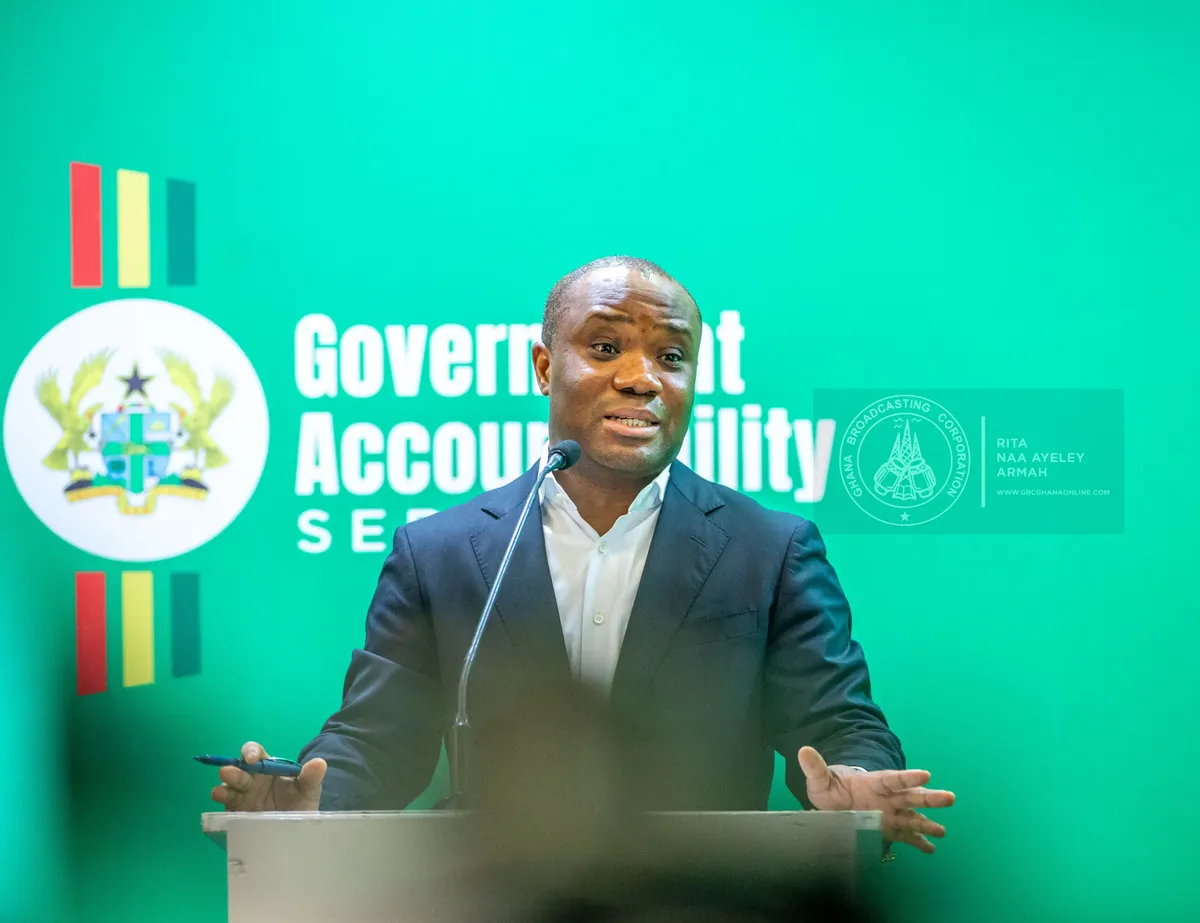
Dr. Cassiel Ato Forson, Finance Minister and outgoing Chairman of the EBID Board of Governors, gave the institutional strengthening agenda its sharpest edge. A 2022 Board decision had raised EBID’s authorised capital from US$1.5billion to US$3.5billion and a third tranche of subscriptions worth US$411.4million, with a December 2025 deadline for full payment. That deadline has passed with the obligation largely unmet.
“To date, only four member-states – namely, Ghana, Côte d’Ivoire, Guinea and Togo – have fully met their obligations. While US$102.5million was received in 2025, outstanding arrears still stand at approximately US$256million,” Dr. Forson said.
The implication for the Bank’s operating capacity was direct, he added: “Timely capital payments are critical. They strengthen EBID’s leverage and sustains its growth and impact across our region.”
The disclosure stood in contrast to an otherwise strong performance report. Dr. Forson acknowledged the difficult operating environment, describing 2025’s global economy as defined by a ‘Great Wedge’ – a divergence in growth dynamics between economies surging on artificial intelligence investment and those weighed down by trade policy volatility and weak external demand – before noting that the Bank had nonetheless risen above it.
“EBID did not just weather the storm – we rose above it,” he said. The balance sheet expanded from US$1.97billion in 2024 to US$2.39billion by end-2025, while profitability rose 13.3 percent to US$9.75million. Project approvals increased by 50 percent and commitments surged by over 83 percent to US$813.77million, with energy and transport infrastructure the primary beneficiaries.
“Our decisions will shape the economic future of our Bank and West Africa. The expectations of our citizens are high. They look to us for results. The future will only be built by deliberate and collective action,” Dr. Forson added.
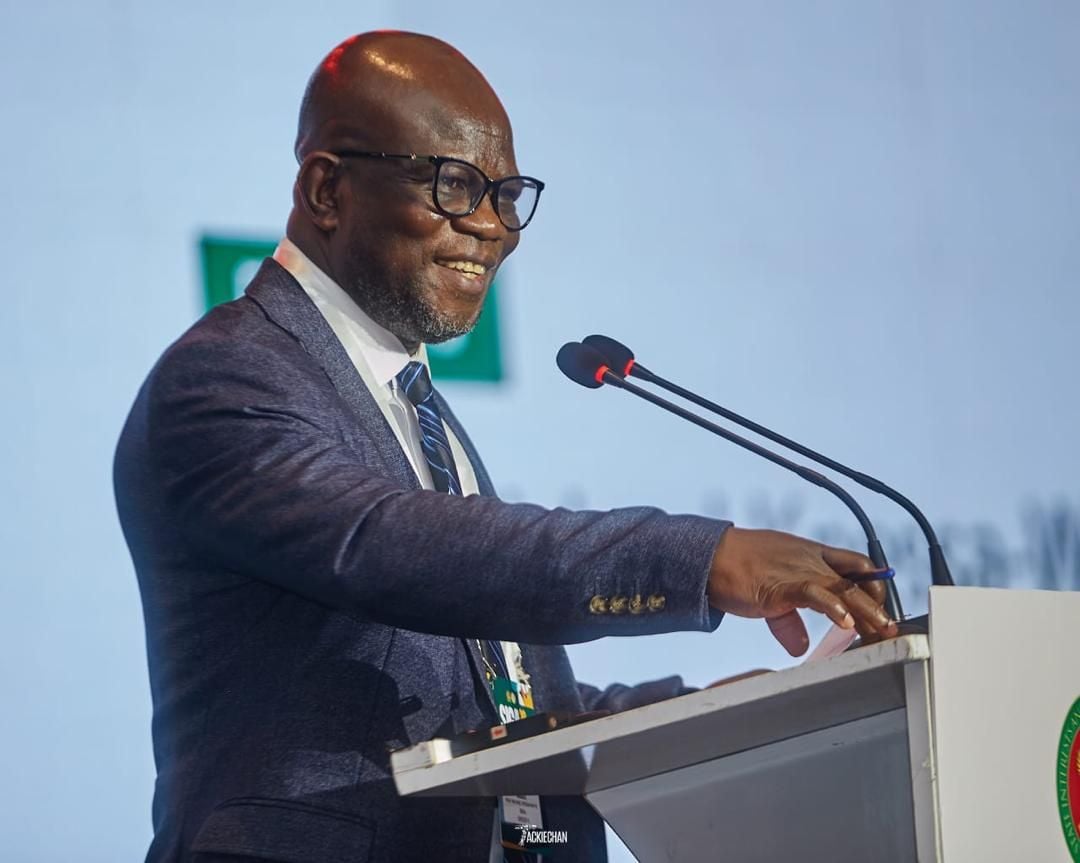
EBID President and Board Chairman Dr. George Agyekum Donkor provided the operational detail underpinning those figures. New disbursements in 2025 reached US$722million, a 47.7 percent increase on the prior year – lifting the Bank’s annual disbursement rate to approximately 26.5 percent from 20.4 percent in 2024. The Bank appraised 25 projects worth US$1.4billion, a 55.81 percent increase in value on 2024 – and mobilised over US$510million and €310million in resources from development partners during the year.
Moody’s and Fitch reaffirmed the Bank’s ratings at B2-Stable and B-Stable respectively and the Bank secured accreditation with the Green Climate Fund, opening new pathways to climate finance for member-states.
For the medium-term, Dr. Donkor outlined EBID’s GRO Strategy for 2026–2030 which is anchored on growth, resilience and optimisation. It commits to directing at least 63 percent of new commitments toward private enterprises and dedicating over 41 percent of resources to climate mitigation and social development.
The Bank, he added, is targetting the mobilisation of approximately US$2billion to diversify its funding base and is working toward strategic partnerships with the African Development Bank and Arab Bank for Economic Development in Africa, moves Dr. Donkor described as potentially game-changing for EBID’s credit standing and resource mobilisation capacity. A second regional office is planned for Abuja in 2026, following the opening of an office in Abidjan.
The urgency behind calls to scale is grounded in a widening structural deficit. West Africa’s annual infrastructure financing gap was estimated at between US$20billion and US$36billion as recently as 2022 – a figure that has grown as climate adaptation, energy transition and digital connectivity demands have accelerated.
Governments across the region have historically depended on international development partners to fund capital projects, in part because large shares of national budgets are committed to recurrent expenditure – leaving limited fiscal room for infrastructure investment. Against that backdrop, an institution disbursing US$722million annually, however improved, remains a modest instrument relative to the scale of regional need.
The post Institutional strengthening, prudent borrowing top agenda appeared first on The Business & Financial Times.
Read Full Story









Facebook
Twitter
Pinterest
Instagram
Google+
YouTube
LinkedIn
RSS