


By Ernest Bako WUBONTO
The e-Crime Bureau Executive Chairman, Dr. Albert Antwi-Boasiako, has expressed concern that traditional degree programmes are producing graduates who cannot operate in real-world threat environments because curricula have not kept pace with the speed and complexity of AI-driven attacks.
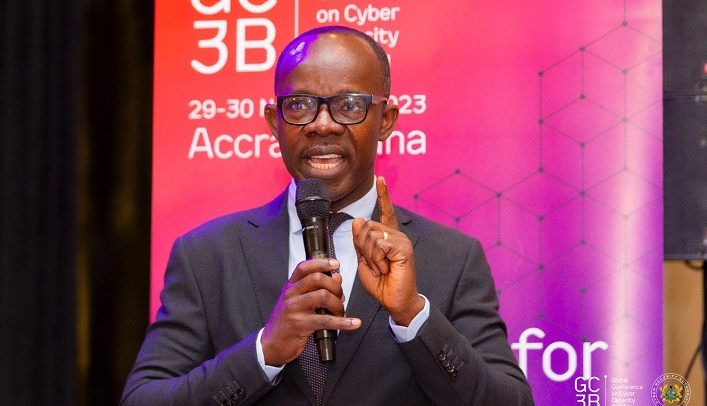
The former Director-General of the Cyber Security Authority (CSA), delivering a keynote address at the official launch of two new Master of Science programmes at Accra Metropolitan University (Accra MET), highlighted that higher education faces an epistemological crisis in which what students learn today may be obsolete by the time they graduate.
“We are educating students for certainty in a world defined by uncertainty. The old model of education has largely equated academic certification with competence and ultimately, degrees with capability – that is the credential illusion we must now confront,” he said.
To address this, he called for a structural reorientation of cybersecurity and intelligence education away from the passive transfer of information and toward what he described as the formation of disciplined judgment.
“Curricula must build core competencies, threat analysis, digital forensics, intelligence synthesis, counterintelligence analysis, offender profiling and risk-based decision-making through exposure to live environments, simulations and real investigations,” he stressed.
He argued that students must be trained not only to use algorithms but also interrogate them: to identify embedded assumptions, biases, limitations and security implications.
Dr. Antwi-Boasiako’s caution follows the university’s introduction of MSc programmes in Cybersecurity and Digital Forensics and Security and Intelligence.
He also used the platform to critique how such disciplines are conventionally taught.
He argued that the defining feature of the present age is not digital transformation in general but the ascendancy of what he termed the “Algorithmic Era”, which he explained as a civilisation-altering shift in which computational logic increasingly determines what people see, know and are offered; often through processes that remain largely invisible and unaccountable.
Citing Check Point Research (CPR) data, Dr. Antwi-Boasiako noted that organisations globally now face nearly 2,000 cyberattacks per week on average – a figure that has more than doubled in recent years.
AI-driven attacks including automated phishing, AI-assisted malware and synthetic identity fraud can now execute in seconds and spread across systems in under 30 minutes. Meanwhile, the Global Cybersecurity Outlook survey indicates that 72 percent of respondents reported increased cyber risks linked to the growing capabilities of generative AI to strengthen attack strategies.
Yet despite this acceleration, traditional education models remain anchored to structured answers, predictable outcomes and siloed disciplines.
“Cybersecurity is taught without law, intelligence without ethics and technology without philosophy.” The result, Dr. Antwi-Boasiako elaborated, is a widening and dangerous gap between what is taught and what is required when graduates enter operational environments.
The implications of this gap extend beyond curriculum design to national security and economic resilience.
The Fortinet Annual Skills Gap report estimates the global cybersecurity workforce gap at approximately four million professionals, with over 70 percent of organisations reporting a shortage of job-ready talent.
Dr. Antwi-Boasiako stressed that the crisis is not one of quantity, indicating that there is no shortage of graduates but of relevance.
“The most dangerous failures in this era are not technical; they are failures of judgment because information is not intelligence. Intelligence requires interpretation and interpretation requires human consciousness,” he added.

Acting Vice-Chancellor of Accra Met, Professor Goski Alabi, in her remarks emphasised: “The two new programmes we developed – in collaboration with the e-Crime Bureau – to bridge the gap between curriculum and capability ensure that students gain not only knowledge but also hands-on experience, industry exposure and professional relevance.
“At Accra Met, we do not simply train students; we develop capable professionals. Our programmes in Cyber Security, Digital Forensics and Security & Intelligence are deliberately designed to respond to evolving demands of the digital and security landscape,” she said.
She further emphasised that this partnership is particularly significant because it embeds practical learning, intelligence-driven insights and real-case exposure into academic delivery.
“Our students will benefit immensely from this collaboration, which will allow them to emerge as graduates who are not just qualified but truly industry-ready,” she reiterated.
The public lecture was held under the theme ‘From Curriculum to Capability: Cybersecurity and Intelligence Education in the Algorithmic Era’.
Prof. Mrs. Alabi said the collaboration is a testament to Accra Met’s focus on the industry-integrated approach.
“Let me say that the university has a similar collaboration with the Electricity Company of Ghana for its MSc. Energy Management and Policy Programme as well,” she revealed.
The post Cybersecurity education failing in ‘Algorithmic era’ – e-Crime Bureau Chief warns appeared first on The Business & Financial Times.
Read Full Story





Facebook
Twitter
Pinterest
Instagram
Google+
YouTube
LinkedIn
RSS