
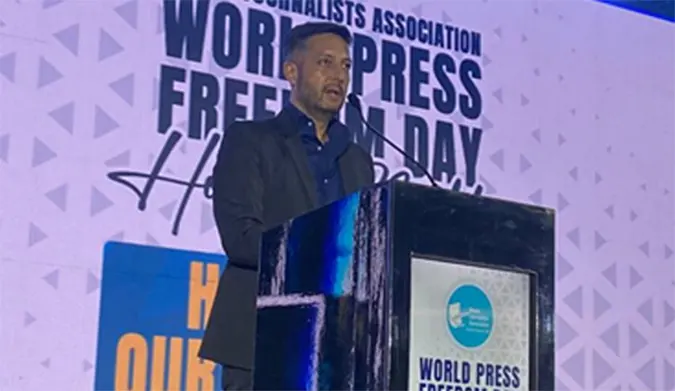

Matthew Asada
The Press Attaché at the U.S. Embassy in Accra, Matthew Asada, has called for the protection of free speech, insisting that democratic societies must uphold the right to expression even when opinions are unpopular or uncomfortable.
Speaking at this year’s World Press Freedom Day celebration organised by the Ghana Journalists Association (GJA), Mr. Asada said freedom of expression loses its meaning when it is protected only under convenient circumstances.
“Societies that only protect speech when it is convenient or popular are not truly protecting the right at all,” he stated.
Addressing the event, which was held on the theme, “Shaping a Future at Peace: Promoting Press Freedom for Human Rights, Development and Security,” Mr. Asada said democracy thrives on the free exchange of ideas and viewpoints.
He linked the principle to Ghana’s democratic progress, noting the country’s rise to 39th position in the 2025 World Press Freedom Index compiled by Reporters Without Borders. According to him, the ranking reflects Ghana’s enduring tradition of open debate and a vibrant media environment.
However, he cautioned that emerging threats in the digital age, including disinformation, online harassment and broadly defined “false news” laws, continue to pose challenges to media freedom.
Citing figures from the Media Foundation for West Africa (MFWA), Mr. Asada said Ghana recorded 14 arrests related to false news and offensive speech within a period of less than 16 months.
“That is nearly double the number documented during the previous administration’s entire eight-year tenure,” he said.
While acknowledging the need to hold perpetrators accountable for attacks on journalists, he warned against the misuse of laws intended to combat false information.
“Prosecuting those who assault journalists is a democratic imperative, but so too is ensuring that laws against false news are not used as tools to silence critics, political opponents or inconvenient voices,” he stressed.
Mr. Asada further noted that protecting free speech requires continuous investment in professional education and ethical journalism. He said journalists should receive training through universities, professional bodies such as the GJA, and media and technology companies.
He also urged media practitioners to maintain high ethical standards across all fields of reporting, including politics, sports and national security.
“Ghana has long been regarded as one of West Africa’s most stable democracies with a relatively vibrant media landscape, which is why we all love it so much,” he said.
He added that the country’s democratic reputation should be safeguarded through tolerance and respect for differing opinions.
“That reputation is worth protecting, and is protected not by silencing critics, but by tolerating them,” he stated.
Mr. Asada reaffirmed the United States’ commitment to democratic principles as the country marks its 250th anniversary.
“As the United States enters its 250th year, we renew our commitment to the principles our founders considered indispensable, and we are proud to stand alongside Ghana’s journalists and citizens in that same cause,” he said.
Also speaking at the event, the Head of the UNESCO Office in Accra, Edmond Moukala, reaffirmed the organisation’s commitment to safeguarding press freedom worldwide.
Mr. Moukala said UNESCO has remained at the forefront of global efforts to promote freedom of expression and the safety of journalists since the United Nations General Assembly proclaimed World Press Freedom Day in 1993 following the Windhoek Declaration.
“Our commitment to the safety of journalists and the promotion of freedom of expression is rooted in the very soul of the UNESCO Constitution,” he said.
He commended President John Dramani Mahama for initiatives aimed at advancing media freedom in Ghana and praised the Ghana Journalists Association for its steadfast commitment to professional excellence.
Mr. Moukala described the GJA as a beacon for the region and acknowledged its leadership role in promoting press freedom and responsible journalism across the country.
BY Prince Fiifi Yorke
Read Full Story




Facebook
Twitter
Pinterest
Instagram
Google+
YouTube
LinkedIn
RSS