


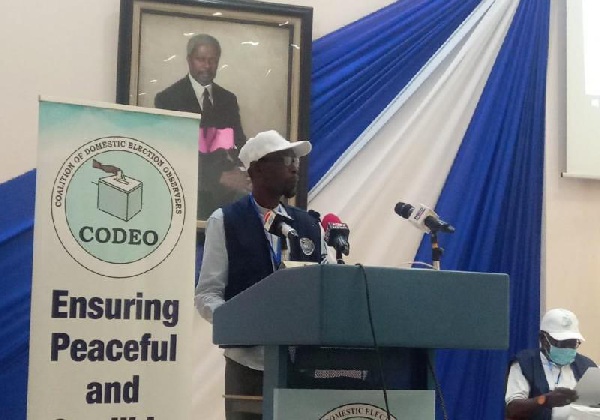
On Wednesday, December 07, 2016, the Coalition of Domestic Election Observers (CODEO), which consists of 42 professional, faith-based organizations and civil society groups, deployed about 8,000 trained, accredited, independent and non-partisan observers spread across the 275 constituencies located in the 10 regions of Ghana. Of this number, 1,500 were assigned to a Parallel Vote […]
The post Preliminary statement on Presidential and General Elections by CODEO Introduction appeared first on The Chronicle - Ghana News.
On Wednesday, December 07, 2016, the Coalition of Domestic Election Observers (CODEO), which consists of 42 professional, faith-based organizations and civil society groups, deployed about 8,000 trained, accredited, independent and non-partisan observers spread across the 275 constituencies located in the 10 regions of Ghana. Of this number, 1,500 were assigned to a Parallel Vote Tabulation (PVT) sample and another 2,500 to over-sampled polling stations. These polling stations were carefully selected to ensure national representation. Another 1,500 observers were purposively deployed to observe the polls at polling stations in flashpoint constituencies, while 750 apiece were assigned to polling stations in stronghold and highly competitive constituencies, respectively. These observers are Ghanaians, from every walk of life, who volunteered their time to help ensure that every registered voter freely cast his or her ballot on election-day and helped ensured that the people of Ghana had independent non-partisan information on the conduct of these elections.
This Preliminary Statement provides highlights of CODEO’s findings regarding the conduct of the presidential and general elections. It incorporates updates of some of the information made available to the public in the “Mid-Day and Close of Polls Situational Reports” released on Wednesday December 7, 2016. This Preliminary Statement is based on reports CODEO received from 1,447 of 1,500 PVT Observers (i.e. 96.5%) from every region and constituency, with the exception of Jaman North in Brong Ahafo region, as of midnight on Wednesday December 7, 2016. Due to problems with the quality transfer voters’ list voting was suspended in Jaman North until Thursday December 8, 2016. CODEO deployed 19 observers, including five PVT observers, in Jaman North on Wednesday December 7, 2016 and CODEO is again deploying them today Thursday December 8, 2016.
Summary of Observations
At 99% of polling stations, electoral officials respected CODEO observers’ status as the Electoral Commission (EC)’s accredited election observers and permitted them to observe the polls. Only 1% initially had challenges, which were quickly and successfully resolved. Preliminary analysis of CODEO PVT observer reports on Set-up and opening of polls, voting and counting from every region and every constituency, except Jaman North where voting has been suspended to today, show that the December 07, 2016 general elections were generally conducted in accordance with the electoral laws and procedures of Ghana. While there were some challenges, they were isolated and did not undermine the overall credibility of the process.
Arrival at Polling Stations
? CODEO Observers reported that by 8:00 am EC election official had arrived at 81% of all polling stations (see Table 1). Of note, in Greater Accra EC election officials were present at 92% of polling stations by 7:00 am.
Set Up for Polls
? By 7:15AM, over half of the polling stations (60%) had opened (see Table 2). Another 32% opened between 7:16 and 8:00AM adding up to 92% opening by 8:00AM.
? There were exactly 5 election officials present at 81% of polling stations. At 12% of the polling stations the presiding officers were women.
? 90% of polling stations were set up so voters could mark their ballots in secret.
? 96% of polling stations were accessible to persons with disability and the elderly.
? At the time of set up, the two main political parties had their party agents present in almost all polling stations – NDC, 99.3%; NPP, 99.5% respectively (see Table 3). The presence of party agents of the other parties fielding presidential candidates and independent presidential candidate varied from 12.3% to 28.4% of polling stations while party agents for parties only contesting the parliamentary election were present in 7.3% of polling stations.
? At the time of opening, 91% of polling stations had all election materials. Of note, the voter register was available in almost all polling stations (99%) while 96% of polling stations had two and biometric verification devices.
? At 99.9% polling stations, the presidential and parliamentary ballot boxes were shown to be empty, sealed and placed in public view before the commencement of voting.
? According to observers, in 99% of the polling stations, ballot booklets were serialized and in numeric order.
? Uniformed security personnel were at post at 88% of polling stations.
Voting
? At 99.5% of polling stations, CODEO observers report that election officials validated (i.e. stamped) ballot papers before they were issued to voters.
? The biometric verification machines failed to function properly at some point in 6% of polling stations. This problem was slightly more prevalent in polling stations in Ashanti (10%) and Upper West (10%) regions.
? At 56% of polling stations, no one with a valid voter ID card had his or her fingerprint rejected by the biometric verification device (BVD) (see Table 4) while at 37% of polling stations a few voters (1 to 5) with valid voter identity cards had their finger prints rejected by the BVD.
3
? In 95% of polling stations, no voter who could not be verified electronically was denied manual verification. Election officials in 99% of polling stations never permitted any voter to vote without being verified either electronically or manually. While in vast majority polling stations (91%), no eligible voter with a valid voter identity was denied his/her voting right.
? In 97% of polling stations, CODEO observers reported that nobody without valid voter identity card or whose name was also not on the voter list was permitted to vote. At just 2% of polling stations a few voters (1 to 5) were permitted to vote although their names were not found in the voters’ register.
? At 93% of polling stations, no unauthorized persons were allowed to be present during voting.
? No major incident of harassment and intimidation of voters or polling officials was recorded at 97% of polling stations.
? In the vast majority of polling stations (96%), the elderly, pregnant women, nursing mothers and persons with disabilities were given priority to vote before others.
? In almost every polling station (98%), the fingers of voters were marked with indelible ink.
? At 13% of polling stations, no one was assisted to vote (see Table 5). However, at 54% of polling stations a few voters (1 to 5) who are elderly persons or with disability were assisted to vote while at 23% of polling station some voters (6 to 15) were assisted to vote, and at 10% of polling stations many voter (16 or more) were assisted to vote.
Counting
? At the close of polls, 52% of polling stations had no queue. Of those polling stations with queues at the close of poll (87%), all voters who were in the queue at 5:00PM were permitted to vote. At the same time, in 54% of polling stations, no voter arrived after 5:00PM. Of those polling stations at which people arrived after 5:00 pm (93%) none of these people were permitted to vote.
? CODEO observers in 98% of polling stations reported that there were no incidents of harassment and intimidation of polling officials, party/candidate agents or observers during the counting of ballots.
? No party agent was prevented from observing the vote count in 97% of polling stations. Similarly, in 96% of polling stations, no unauthorized person was permitted at the inner perimeter or cordoned area during the counting of ballots.
? In the vast majority of the polling stations (90%), no political party agent requested for a recount as far as the presidential ballot was concerned.
? Critically, at nearly all polling stations, the agents of the NDC (98%) and NPP (99%) signed the presidential result declaration form. Presiding officers in 99% of polling stations also endorsed the form. Further, at 99% of polling stations CODEO’s PVT Observers also agreed with the presidential results.
? At 83% of polling stations the official results for the presidential election was posted in a visible place for the public to see (see Table 6).
4
? All political party agents in 82% of polling stations as well as the presiding officer in 99.8% polling stations signed the parliamentary results declaration form. In addition, 99.6% of CODEO Observers reported they agreed with the parliamentary results at their polling station.
Reported Incidents
CODEO observers reported a total of 436 cases verified incidents during opening, voting and counting stages of the polling process throughout the country (See Tables 7A & 7B). out of this total, incidents around harassment and intimidation of polling officials, and voters was the most recorded (116) incidents of polling station either not open or opened late (66) unauthorized persons at polling stations (44) violence (34) voting or counting suspension (31) and polling stations running out of material (30). Most of these cases were quickly resolved by polling officials and key election stakeholders, such as the security services, and thereby did not affect the polling process.
Conclusion
From the foregoing, CODEO in this preliminary situational report can confidently confirm that the arrangements put in place by the EC for setup and opening of polls were adequate for most polling stations, and that the polling and counting processes were generally credible.
CODEO is continuing to observe the process. In addition, to observers deployed to the 275 constituency collation centers, as well as at the National Results Collation Center (NRCC) in Accra, CODEO deployed observers across Jaman North constituency to observe voting and counting there today.
For the 274 constituencies that voted on Wednesday December 7, 2016, CODEO has completed its PVT and has its estimates for the presidential election results. In keeping with our protocols, CODEO will release its PVT estimates for the presidential election results following the official announcement by the EC in order to provide independent verification of their accuracy. Thus, CODEO PVT serves as a powerful deterrent to help ensure that the results announced by the EC reflect the ballots cast at polling stations. Accordingly, CODEO condemns attempts by political parties to declare results prior to the official announcement by the EC. We urge all political parties and citizens to be law abiding and to allow the EC to complete its work.
In closing, CODEO again appeals to all Ghanaians to remain calm and wait for the EC to declare the official results. Voting has not yet finished in Jaman North and collation of results continues across the country.
CODEO December 7, 2016 election observation exercise was made possible with the generous support of the American people through the United States Agency for International Development (USAID) and the Embassy of the Kingdom of Netherlands.
The post Preliminary statement on Presidential and General Elections by CODEO Introduction appeared first on The Chronicle - Ghana News.
Read Full Story







Facebook
Twitter
Pinterest
Instagram
Google+
YouTube
LinkedIn
RSS