
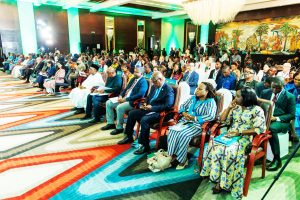

The World Bank has launched its “Fit to Prosper” strategy aimed at strengthening health systems and driving job creation across West and Central Africa, as countries in the region face mounting pressure from rising disease burdens and constrained financing.
The strategy was unveiled at a high-level event in Accra, hosted at the Mövenpick Ambassador Hotel, and attended by ministers of health and finance, development partners and regional stakeholders.
Opening the event, the Minister for Health, Kwabena Mintah Akandoh, described the strategy as timely, noting that the region’s health challenges from communicable diseases and malnutrition to rising non-communicable diseases and climate-related risks—require coordinated and forward-looking solutions. He stressed that no country can build a strong economy on a weak health system and called for sustained investments in accessible, affordable and quality healthcare.
He highlighted key government interventions, including the Free Primary Healthcare initiative and the Ghana Medical Trust Fund (MahamaCares), aimed at reducing financial barriers and strengthening the continuum of care.
Delivering welcome remarks, World Bank Division Director, Robert Taliercio praised Ghana’s leadership in health sector reforms and its role in shaping regional dialogue. He pointed to Ghana’s progress in reducing childhood stunting and improving health outcomes as evidence that sustained investments in health deliver measurable results.
He also commended President John Dramani Mahama’s “Accra Reset” initiative, describing it as a strong signal of political commitment to reshaping global health financing and strengthening African ownership of development priorities.
In remarks delivered on behalf of the Presidency, the Chief of Staff emphasised that health must be seen as a core economic strategy, stressing that a healthy population is essential for productivity, innovation and resilience.
She noted that the World Bank’s regional health portfolio—spanning over 20 countries with billions of dollars in financing—has contributed significantly to improving maternal and child health outcomes and strengthening pandemic preparedness across the region.
The Chief of Staff further highlighted Ghana’s own efforts to strengthen its health system, including reforms to boost domestic financing, the uncapping of the National Health Insurance Levy, and the rollout of the Free Primary Healthcare initiative. She also announced plans to launch a Country Compact with the World Bank to align resources and reforms under a unified national vision.
She underscored the importance of regional cooperation, noting that health security cannot be achieved by countries acting alone, and called for stronger collaboration in disease surveillance, emergency response and local manufacturing of essential health products.
The “Fit to Prosper” strategy seeks to help countries prioritise high-impact health investments within constrained fiscal space, while advancing job creation and economic growth. It aligns with broader efforts to achieve Universal Health Coverage and support local production of essential medicines under the Africa Initiative for Medical Access and Manufacturing.
Participants at the event stressed the need for effective implementation, accountability and sustained commitment to ensure the strategy delivers tangible improvements in people’s lives.
For more news, join The Chronicle Newspaper channel on WhatsApp: https://whatsapp.com/channel/0029VbBSs55E50UqNPvSOm2z
The post World Bank lauds Mahama’s health policies appeared first on The Ghanaian Chronicle.
Read Full Story






.jpg)


Facebook
Twitter
Pinterest
Instagram
Google+
YouTube
LinkedIn
RSS