


Vice President Professor Jane Naana Opoku-Agyemang has called on African countries to take greater control of their food systems by investing strategically in agriculture, reducing dependence on food imports and strengthening regional cooperation to build resilient economies.
Speaking at the West Africa Rice Investment Roundtable in Accra on Tuesday, the Vice President said recent climate shocks, geopolitical tensions, export restrictions and trade tariffs had exposed the fragility of global food systems and underscored the dangers of excessive reliance on imported food.
“Countries that import too much food also import vulnerability,” she said, stressing that food security extends beyond agriculture and is closely linked to macroeconomic stability, social protection, national security and geopolitical independence.
Professor Opoku-Agyemang noted that despite its fertile land, abundant water resources, entrepreneurial farmers and youthful population, Africa continues to spend more than US$50 billion annually on food imports, with rice accounting for a significant share of that expenditure.
She said the challenge confronting West Africa was not merely to increase rice production but to mobilise the investment needed to transform agriculture from a subsistence activity into a modern commercial industry capable of creating jobs, strengthening regional trade and driving economic growth.
She added that Ghana viewed the challenge as an opportunity to build resilient food systems, industrialise agriculture and reclaim greater control of Africa’s food future.
The Vice President’s remarks were reinforced by Minister for Food and Agriculture, Eric Opoku, who outlined Ghana’s plans to eliminate its rice deficit and achieve self-sufficiency within the next decade.
According to the Minister, Ghana consumed approximately 1.71 million tonnes of rice last year but produced only about 960,000 tonnes, leaving a deficit of roughly 751,000 tonnes and a self-sufficiency rate of 56 per cent. The country consequently spent about US$320 million on rice imports.
“Our rice deficit is not simply a burden on our balance of payments. It is the single largest untapped agribusiness opportunity in our staple food economy,” he said.
To address the challenge, Mr. Opoku announced a rice import quota policy that would require importers to demonstrate verified partnerships with local rice producers before import permits are granted.
He also disclosed that government had completed advanced satellite-based mapping of rice-suitable lands across the country to provide investors with verified and location-specific investment opportunities. He said Ghana could achieve 100 per cent rice self-sufficiency within 10 years, save an estimated US$2.1 billion in foreign exchange, attract more than US$400 million in private investment and create over 200,000 jobs.
President of the ECOWAS Commission, Dr. Omar Alieu Touray, placed the discussions within the broader regional agenda, describing rice as a strategic commodity central to food security, economic growth and regional integration.
He said ECOWAS Heads of State endorsed the Regional Rice Roadmap (2025–2035) in 2024 to provide a common framework for investments and interventions aimed at achieving rice self-sufficiency across West Africa.
While regional rice production increased by 44 per cent between 2008 and 2024 Dr Touray noted that demand continued to outstrip supply, forcing the region to rely heavily on imports.
He said ECOWAS remained committed to building competitive, inclusive and sustainable Agrifood systems capable of achieving regional rice self-sufficiency by 2035.
The ECOWAS Commission President described the roundtable as a critical turning point from planning to implementation and urged governments, development partners and investors to strengthen partnerships, accelerate financing and support bankable projects across the rice value chain.
Deputy Minister for Finance, Thomas Nyarko Ampem, also called for increased investment in the sector, arguing that West Africa’s challenge was not a lack of agricultural potential but inadequate transformational capital.
He observed that the region continues to spend between US$3 billion and US$4 billion annually on rice imports despite possessing the land, water resources and human capacity needed to produce more of its own rice.
Mr. Ampem said transformational capital must go beyond seasonal financing and support irrigation, storage, milling, logistics and processing infrastructure capable of unlocking the full potential of the rice economy.
He maintained that rice should be viewed not only as a food security issue but also as a vehicle for industrialisation, job creation and macroeconomic resilience.
“The time for talking about West Africa’s rice potential is over. The time for financing it is now,” he said, urging stakeholders to move from dialogue to concrete investments capable of transforming the region’s rice sector.
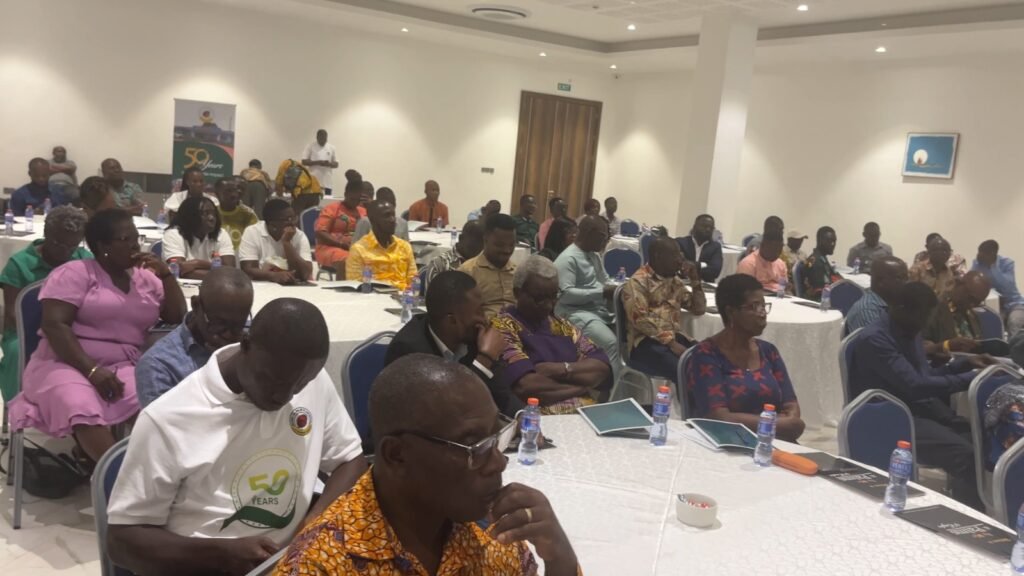
The roundtable, organised by the World Bank in partnership with the Government of Ghana and the ECOWAS Commission under the theme, “Setting the Vision, Presenting Investment Opportunities,” seeks to mobilise financing for the implementation of the Regional Rice Roadmap, which requires an estimated US$15 billion to US$19 billion in capital investments and an additional US$4 billion to US$5 billion in operating costs to accelerate rice self-sufficiency across West Africa.
For more news, join The Chronicle Newspaper channel on WhatsApp: https://whatsapp.com/channel/0029VbBSs55E50UqNPvSOm2z
The post Africa must take control over its food systems -Veep appeared first on The Ghanaian Chronicle.
Read Full Story







Facebook
Twitter
Pinterest
Instagram
Google+
YouTube
LinkedIn
RSS