
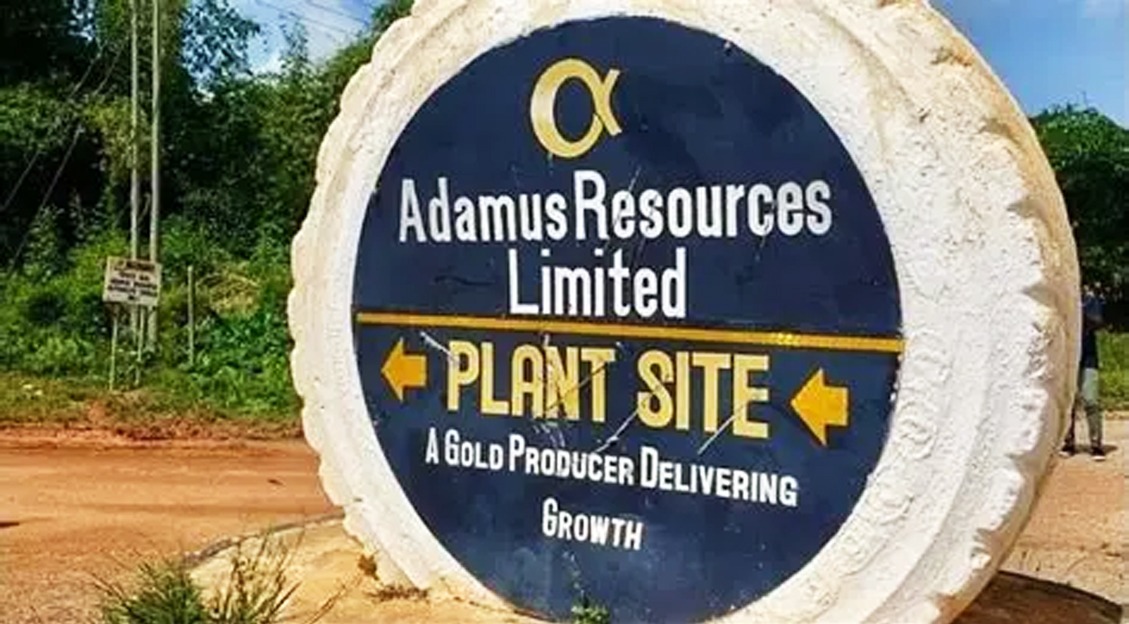

The Ministerial Review Committee has explained that the recent revocation of Adamus Resources Limited’s mining lease goes beyond allegations of illegal mining and regulatory breaches.
The Ministerial Review Committee was established by the Lands and Natural Resources Minister, Emmanuel Armah-Kofi Buah, after Adamus Resources petitioned against the revocation of its Nkroful, Akango and Salman mining leases.
The committee was chaired by Prof. Jerry Samuel Yaw Kuma and was tasked with independently examining the circumstances surrounding the revocation and making findings and recommendations.
According to the Committee, the financial record raises questions regarding the loss of revenue to Ghana following failure of the company to meet its statutory financial obligations.
According to the Ministerial Review Committee’s findings, Adamus Resources was in arrears of GHS86.78 million in royalties payable to the Minerals Income Investment Fund (MIIF) from 2020.
The company also had GHS119.04 million in tax arrears to the Ghana Revenue Authority (GRA) dating from 2023, together with US$2.56 million in annual payments owed to the Minerals Commission.
The figures put the company’s total statutory arrears at approximately GHS205.83 million, plus US$2.56 million, representing money that should have gone to the state as part of the company’s obligations for extracting Ghana’s mineral resources.
It was disclosed that the company’s unpaid obligations are considered alongside the movement of money to related parties and that Adamus Resources transferred more than US$224.61 million to related parties between 2020 and 2024, according to its financial statements.
The Committee’s findings revealed that out of the US$224.61 million transferred to related parties, approximately US$123.14 million was transferred to Segala Mining Corporation SA, Semico 1 and Semico 2 in Mali, for which the committee rejected the explanation that the failure to pay statutory obligations was simply caused by a lack of cash or temporary financial difficulties concluding that failure to pay statutory obligations pointed to deliberate non-compliance.
The Committee noted that the financial misconduct is not simply that Adamus Resources owed the state money, but the major concern was that while substantial statutory obligations remained outstanding, millions of dollars were still being transferred to related companies, which practically suggested that money was available for significant transactions within the corporate group, yet payments due to the Ghanaian state were left outstanding.
The committee noted that these related-party transfers occurred while the company was already in significant arrears, thus weakening the argument that the transactions were merely routine business activities.
It said that for a country whose mineral resources are constitutionally held in trust for the people, a mining company which extracts gold and keeps the proceeds as private income and does not declare its production accurately and pay the royalties, taxes and other statutory charges required by law, raises a serious public-interest concern.
“The failure to pay those obligations therefore has implications beyond Adamus.
Resources’ balance sheet. Every cedi in unpaid royalties or taxes potentially represents revenue that the state cannot deploy for public services, infrastructure and national development”, the Committee noted.
The committee also uncovered significant outstanding debts owed by Adamus Resources to institutions including GOIL and GRIDCo, in addition to the statutory arrears already identified in the report.
The committee also uncovered serious inconsistencies in the company’s gold production and export records in which Adamus Resources reportedly failed to produce its statutory Gold Production Book, forcing the committee to rely on Form 16A monthly returns and royalty returns submitted to the GRA.
According to the Committee, between 2020 and January to March 2026, discrepancies between Form 16A records and GRA royalty returns amounted to 6,580.04 ounces of gold, with the committee estimating the associated revenue variance at approximately US$27.13 million using the Bank of Ghana rate of July 12, 2026.
The figures reported by the various state institutions also failed to match; for example, between the years 2024 to 2026 January to March, Adamus reports show the company reported 72,194.94 ounces of Gold to GRA and that same period the company reported 71,553 ounces of Gold to Minerals Commission whilst the company’s own record of shipments of Gold stood at 74,375.14 ounces of gold.
The committee identified additional variances from those figures, including one equivalent to about US$12.02 million and another estimated at approximately US$21.30 million. These discrepancies matter because the amount of gold produced and exported directly affects the royalties and taxes that should be paid to the state.
The committee subsequently described the records as “suspicious” and concluded that they had been prepared with the purpose of evading statutory liabilities. If established through the appropriate enforcement and legal processes, such conduct would represent far more than poor bookkeeping.
Concerns by Eastern Nzema Traditional Area
Besides taxes and royalties owed directly to the central government, the Committee also pointed to financial concerns raised by the Eastern Nzema Traditional Area over an alleged US$2.5 million outstanding balance from a US$10 million Community Development Fund.
The Traditional Council further alleged that mineral royalties due to it had not been paid for eight years, besides inadequate infrastructure, deteriorating roads, flooding and problems associated with the Salman Resettlement Project which deprived Ghana of the full financial benefit from the extraction and export of its gold.
The committee’s overall assessment was that the breaches identified against Adamus Resources were serious and fundamental to the integrity of its mining leases.
It therefore recommended that the revocation be upheld and called for
additional regulatory, environmental and financial enforcement measures, including a comprehensive audit of the company’s activities.
The alleged failure to pay more than GHS205 million in statutory obligations, alongside US$2.56 million owed to the Minerals Commission, coupled with the reported US$224.61 million in related-party transfers, presents a financial compliance issue that cannot simply be brushed aside as a technical dispute, the Committee’s report indicated.
Adamus defaults on payment of Regulatory fees after earning U$1 billion.
The Committee also pointed to records from the Ghana Revenue Authority (GRA) which indicated that between 2020 and January–March 2026, Adamus Resources reportedly recorded approximately 8.8 tonnes of gold, valued at over US$1 billion.
It said, however, that under the applicable arrangements, 10 percent of the relevant proceeds were expected to be paid to the Minerals Income Investment Fund (MIIF), but the records indicate that the company defaulted on its obligations to MIIF, alongside outstanding tax obligations to the Ghana Revenue Authority, even though the company was reportedly producing gold worth more than US$1 billion.
Late Issuance of Adamus Resources EPA Permits in Ellembelle
The Committee also reported that two Environmental Protection Agency permits issued to Adamus Resources Limited showed that the company received new authorization long after its previous permit had expired, and that the paperwork for both permits was released in the
wrong order.
The documents, both signed by the EPA Deputy Executive Director of Operations, cover gold mining and processing operations in the Ellembelle District of the Western Region.
The first permit, EPA/EMP/313, authorizes operations at Salman and states that the authorization covered the period from 20 July 2017 to 19 July 2020. However, the certificate was officially issued on 19 December 2024, more than four years
after the stated period had already ended, raising serious questions about
how Adamus Resources was able to operate under the permit before the document was officially issued.
The second permit, EPA/EMP/316, covers the Nzema Gold Mining and Processing Operation and states that the authorization ran from 21 December 2023 to 20 December 2026. However, the certificate was issued on 16 December 2024, meaning the company had already been operating under the stated authorization period for almost a year before the permit was officially issued, thus creating a confusing timeline. The 2017-2020 permit expired in July 2020, but its certificate was not issued until December 2024. In the meantime, the next permit covering December 2023 to 2026 had already started, and its certificate
was also issued late in December 2024, but before the expired one.
The fact that both certificates were issued in the same week in December 2024, and in reverse order, raises questions about EPA’s record-keeping and processing times. It is not clear from the documents why the permits were issued so late or why the older one came after the newer one.
Illegal operations
The documents indeed established that Adamus was operating before the issuance of its EPA permit. The circumstances under which the company was allowed to continue operating without the required environmental clearance warrant serious scrutiny because it shows the company was operating illegally during the four-year period.
For more news, join The Chronicle Newspaper channel on WhatsApp: https://whatsapp.com/channel/0029VbBSs55E50UqNPvSOm2z
The post The Revocation of Adamus License: The Inside Story appeared first on The Ghanaian Chronicle.
Read Full Story


-1200x803.webp)



Facebook
Twitter
Pinterest
Instagram
Google+
YouTube
LinkedIn
RSS