
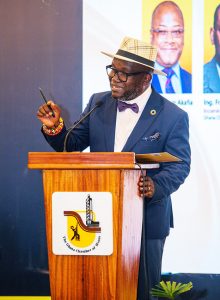

The Ghana Chamber of Mines (GCM)has thrown its weight behind the renewal of Gold Fields Ghana Limited’s Tarkwa mining leases, declaring that the company has “materially met” the terms of its existing lease and warning that denying renewal could undermine investor confidence in Ghana’s mining sector.
The Chief Executive Officer of the Ghana Chamber of Mines, Ing. Dr. Ken Asigbey, said the country’s mining law provides for the extension of a mining lease where the holder has materially complied with its terms, and argued that Gold Fields had satisfied that threshold.
“My answer, and that of any objective reviewer of the facts, will be a resounding yes. They have materially met the terms of their lease,” Dr. Asigbey declared.
He was speaking at the Inter-Mines First Aid and Safety Competition in Tarkwa, where he used the platform to intervene in the increasingly heated debate over the renewal of Gold Fields’ Tarkwa mining leases, five of which, together with the existing development agreement, are due to expire in April 2027.
Gold Fields submitted its application for renewal in November 2025. Dr. Asigbey’s intervention comes after the Apinto Divisional Council, the traditional authority and customary landowners in the area, publicly called on the Government not to renew the company’s leases.
The chiefs have argued that the benefits derived by the host communities do not adequately reflect the scale of mineral extraction and the environmental and socio-economic costs borne by the people.
Amongst the same chiefs, for instance, the chief of Huniso and the Queen mother have mounted a strong defense for Gold Fields lease to be renewed citing massive infrastructure development in the host communities. The youth Associations most especially the Apinto Youth have also mounted strong defense for the mining company calling on the government to renew the company mining lease.
But the Chamber chief cautioned against allowing legitimate community concerns to result in regulatory uncertainty, insisting that the appropriate response should be negotiation rather than the abandonment of a partnership built over decades.
‘Security of tenure is about Ghana’s credibility’
Dr. Asigbey said the debate over Gold Fields’ lease renewal went beyond the future of a single mining company and had implications for Ghana’s credibility as an investment destination.
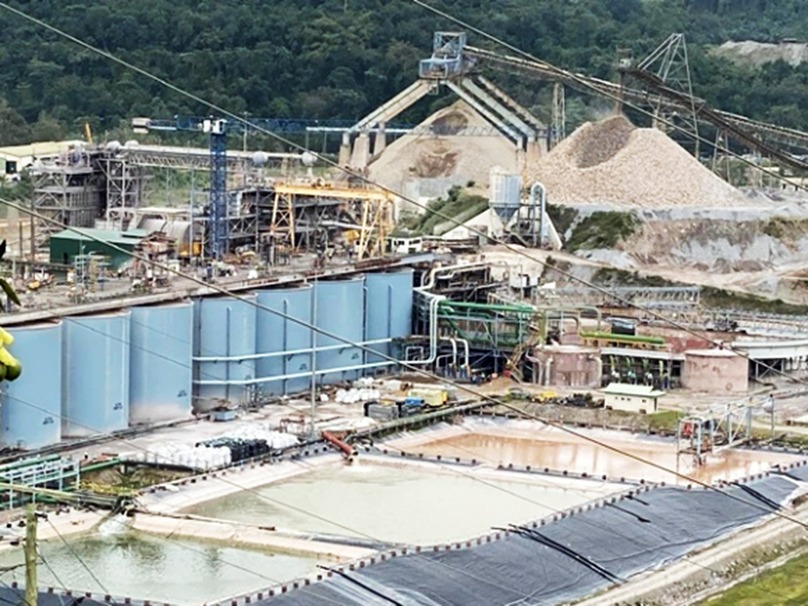
He noted that mining was a long-term, capital-intensive business in which investors commit hundreds of millions, and sometimes billions, of dollars on the expectation that the legal and regulatory environment would remain predictable.
“Security of tenure does not mean that a mining company has an unconditional right to a resource forever,” he said, stressing that companies must comply with Ghanaian laws, fulfil lease conditions, meet environmental and social obligations, protect workers and respect host communities.
But where an investor had fulfilled its obligations, he argued, Ghana must apply its laws predictably and fairly.
“Every mining company currently operating in Ghana is watching. Every company considering investing in Ghana is watching. Banks and other institutions that finance mining projects are watching. The international investment community is watching,” he said.
According to him, investors would ultimately ask a straightforward question: If we invest billions of dollars in Ghana, comply with the law and build a successful operation, will our investment be secure?
The answer, he said, would have consequences for the cost and availability of capital not only in mining, but across the wider Ghanaian economy.
‘Let us negotiate, not create uncertainty’
Dr. Asigbey acknowledged the concerns raised by traditional authorities and community stakeholders over the distribution of wealth generated from Tarkwa’s mineral resources.
Rather than dismissing those concerns, however, he urged the chiefs to place their demands formally before Gold Fields and negotiate a new framework for the next phase of the relationship.
“If ‘Nananom’ believe there are outstanding community needs, let us put those needs clearly on the table,” he said. He said concerns over employment, local procurement, infrastructure, skills development, enterprise development, environmental management and greater community participation could all be addressed through engagement.
“Let us negotiate. Let us hold each other accountable. And let us find common ground that protects the legitimate interests of the people of Tarkwa while preserving the investment, employment and economic ecosystem that has been built here,” he said.
The Chamber’s position is particularly significant because it comes amid a growing campaign by sections of the traditional authorities for a Ghanaian-owned mine to replace Gold Fields at Tarkwa. Dr. Asigbey cautioned that simply changing the ownership or nationality of a mining company would not automatically transform host communities.
“Changing the name on a mining lease, nor changing the nationality of the owner does not automatically transform a community. What transforms communities is good governance, responsible investment that expands the mine, technology, effective partnerships, local participation and the disciplined use of mineral revenues,” he said.
Tarkwa’s economic ecosystem
Defending the broader contribution of Gold Fields to Tarkwa, Dr. Asigbey said the company’s impact should not be assessed solely by the ounces of gold extracted.
He pointed to the economic ecosystem that has developed around the mine over more than three decades, including opportunities for Ghanaian contractors, suppliers, entrepreneurs, transport operators, hotels, restaurants, artisans and other businesses.
He cited investments by the Gold Fields Ghana Foundation in education, health, infrastructure, water and sanitation, enterprise development and agriculture.
Among the major projects, he highlighted the 33-kilometre Tarkwa-Damang road, constructed at a cost of approximately US$27 million, as well as the redevelopment of the Tarkwa and Abosso Stadium, scholarships, health facilities and water projects.
He said cumulative investment by the Gold Fields Ghana Foundation in host-community development had exceeded US$100 million by 2023, with additional investments made since then. He also noted that Gold Fields had become an economic anchor for Tarkwa, creating jobs and enabling Ghanaian businesses to develop capabilities within the mining supply chain.
30% royalties for mining communities
Dr Ashigbey, however, acknowledged that the debate over community benefits had exposed a broader structural problem in Ghana’s mining sector. He called on traditional authorities to support the Chamber’s longstanding proposal for at least 30 per cent of mineral royalties to be returned to mining communities.
He argued that mining communities host mineral resources and bear the environmental and social consequences of mining, yet often continue to experience infrastructure and development deficits despite the substantial royalties generated for the State.
A properly managed 30 per cent allocation, he said, could finance roads, health facilities, schools, water systems, scholarships, technical training and local businesses capable of surviving beyond the life of a mine.
“Mining resources are finite. Every mine will one day close. We must, therefore, use the revenues generated today to build economies that can survive tomorrow,” he said.
He further called for the enactment of a comprehensive Minerals Revenue Management Act to provide clearer rules for the collection, allocation, management and investment of mineral revenues.
For more news, join The Chronicle Newspaper channel on WhatsApp: https://whatsapp.com/channel/0029VbBSs55E50UqNPvSOm2z
The post Tarkwa Mine Lease: Gold Fields Meets Key Renewal Terms — Chamber Of Mines appeared first on The Ghanaian Chronicle.
Read Full Story


Facebook
Twitter
Pinterest
Instagram
Google+
YouTube
LinkedIn
RSS