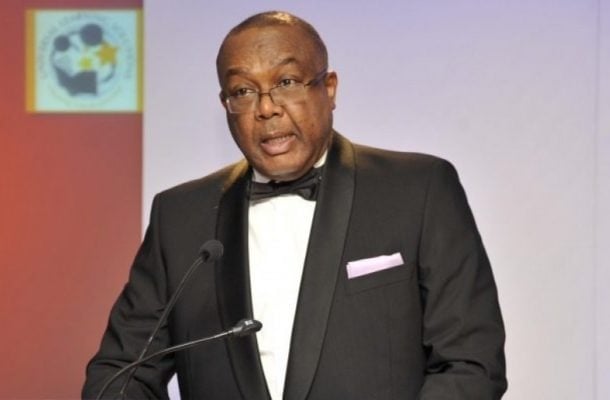
BBC TV presenter Komla Dumor has died suddenly at his home in London at the age of 41, it has been announced. He was said to have died from a cardiac arrest on Saturday. The Ghanaian Broadcast Journalist with BBC World News TV and presenter of Focus on Africa live from London, interviewed a #SouthSudan ex child soldier musician @EmmanuelJAL, on Focus on Africa on Friday at 1730GMT. It was to be his last. He was only last week nominated to be the face of the BBC for the World Cup in Brazil this summer. Former Chief Executive of Kotoko, Mr Herbert Mensah's wife is a neighbour to Dumor in London.  She was present when the doctors pronounced the BBC presenter dead on Saturday. Mr Mensah, himself a close pal of Dumor told Joy FM in Accra that Esther Cobbah, head of Stratcomm Africa, and a friend to the Dumor family has been appointed to speak on the family's behalf. He was married to Kwansema Dumor. They have three children. BBC Global News Director Peter Horrocks called Dumor a leading light of African journalism who would be deeply missed. "Komla's many friends and colleagues across Africa and the world will be as devastated as we are by this shocking news," Mr Horrocks said in a statement. "The sympathies of all his colleagues at the BBC are with his family and friends." Komla Dumor was born on 3 October 1972 in Accra, Ghana. He graduated with a BA in Sociology and Psychology from the University of Ghana, and a Masters in Public Administration from Harvard University. He won the Ghana Journalist of the Year award in 2003 and joined the BBC four years later. From then until 2009 he hosted Network Africa for BBC World Service radio, before joining The World Today programme. In 2009 Komla Dumor became the first host of Africa Business Report on BBC World News. He travelled across Africa, meeting the continent's top entrepreneurs and reporting on the latest business trends around the continent. He interviewed a number of high-profile guests including Bill Gates,  Kofi Annan and former US president Bill Clinton. Last month, he covered the funeral of former South African President, Nelson Mandela, whom he described as "one of the greatest figures of modern history". He anchored live coverage of major events including the 2010 World Cup in South Africa, the funeral of Kim Jong-il, the release of Israeli soldier Gilad Shalit, the Norway shootings and the wedding of Prince William and Kate Middleton. In his review of 2013, published last month, Dumor said the passing of Mandela was "one of the moments that will stay with me". "Covering the funeral for me will always be a special moment. I will look back on it with a sense of sadness. But also with gratitude. I feel lucky to have been a witness to that part of the Mandela story." Dumor was the only West African news reader on the BBC World news until his death. He achieved his feat in journalism without a formal journalism training.
 The Minister of the Interior, Mr Kwesi Ahwoi, on the advice of the Volta Regional Security Council and by Executive Instrument, has renewed the curfew imposed on Alavanyo and Nkonya with effect from Friday, January 17, 2014. A statement signed by the minister said the curfew hours remained from 8:p.m. to 5:a.m. It also said the government continued to urge the chiefs, elders, opinion leaders and people of the areas to exercise restraint in the face of the challenges confronting them and use non-violent means in the resolution of their conflicts and disputes. ‘Meanwhile, government reiterates that there is a ban on all persons in the two towns and their environs from carrying arms, ammunition or any offensive weapons,†the statement said. It said any person found with any arms or ammunition would be arrested and prosecuted.   Â
 Investigations conducted by the National Security Council (NSC) have established that the 1.5 tonnes of supposed gold alleged to have been sold by President John Dramani Mahama to Iran is not true. The gold was supposed to settle Ghana’s financial commitment to Iran over an unknown transaction. The NSC said its investigations had revealed that the samples supposed to have been gold were not gold after all. Briefing the press in Accra yesterday on the outcome of the investigations, Mr Marcus Awelinga of the NSC said investigations indicated that 30 boxes of what was believed to be gold did not contain gold. Rather, they contained substances whose chemical components comprised 0.468 per cent of zinc, 1.24 per cent of tin, 0.310 per cent of iron, 0.101 per cent of silicon, 0.644 per cent of copper, 0.031 per cent of aluminium, 0.25 per cent of gold and 96.13 per cent of nickel. Background On December 31, 2012, there were news reports that President Mahama had sent 1.5 tonnes of gold to Iran to settle financial commitments over an unknown transaction. The consignment was detained in Turkey because the crew could not produce a valid airway bill on it. The issue generated a lot of criticism in the media and, therefore, the NSC initiated an investigation into the matter. Findings of the investigation According to Mr Awelinga, investigations by the NSC had shown that the aircraft which carried the supposed 1.5 tonnes of gold originated from the Kotoka International Airport (KIA) at 10.20 p.m. on December 31 2012. He said checks conducted revealed that the supposed gold was actually supplied by Omanye Gold Mining Limited (OGML) and not President Mahama. Mr Awelinga said Mr Peter Kofi Bedzra, the Director of OGML, now deceased, admitted supplying “gold bars†and that they were loaded from the KIA. He said despite OGML being a registered company, it appeared to be an obscure enterprise. He said the office of OGML could not be located. He explained that that was because its address provided at the Registrar-General’s Department could not be traced. According to Mr Awelinga, the consignment of the supposed gold had been returned to Ghana from Dubai and was now in the custody of Aviance, waiting clearance by OGML (owners). He said OGML had, however, sent a petition to court, claiming it was gold that it exported. He said investigations were ongoing to unravel the truth or otherwise of that claim. Â
 The National Pensions Regulatory Authority (NPRA) has directed pension fund managers to disinvest funds made in non-permitted investment areas immediately upon maturity. According to the acting Chief Executive Officer of the authority, Mr Laud A. K. Senanu, compliance inspection had revealed that some fund managers had made investments in unapproved instruments such as microfinance and non-bank financial institutions to the tune of GH¢32.1 million. Mr Senanu gave the directive at a meeting with stakeholders in Accra on Thursday. Compliance Although the overall compliance level was encouraging within the industry, Mr Senanu said the findings included improper accounting on scheme funds which resulted in delay in crediting the returns on investment to respective contributors, unoperational schemes or schemes established with no beneficiaries signed on, as well as not communicating changes of directorships to the authority. In addition, he said, conflict of interest issues, where the managing director of a trust company doubled as the managing director of a pension fund management company, came up, while some pension fund managers were also investing the funds in their parent or holding companies. Temporary Pension Fund Account Mr Senanu reiterated that the Social Security and National Insurance Trust (SSNIT) would continue to collect tier-two contributions from both employers with and those without schemes until employers were enrolled on schemes to avoid chaos. However, he said the trust would be paid a fee for the collection. Mr Senanu said the NPRA had set up a committee, comprising representatives from SSNIT and the Controller and Accountant-General’s Department, to reconcile collections with contributors and schemes. After that, an independent auditor would be invited to audit the data before transfers of about GH¢1.14 billion being invested at the Bank of Ghana would be disbursed to corporate trustees, he added. He was hopeful that the process would end in about a month for the transfers to be effected within the first quarter of the year. Educational campaign Mr Senanu said the authority would devote a better part of the year to educational campaigns for establishments to register schemes for formal and informal sectors. The authority would also refer to its board the need to provide incentives for corporate trustees that spread their tentacles to the regions. Past credit He said the board of the NPRA was also studying for approval a formula for determining how much of the lump sum of persons below 55 years who contributed to the SSNIT had to be migrated onto the enhanced pensions regime with three-tier contributory levels. The NPRA currently has 86 service providers, including companies with provisional approval status, comprising licensed corporate trustees, pension fund custodians (usually banks) and pension fund managers. The stakeholders called on the NPRA to stick to its own timelines and deliver on its promises to move the industry forward. Rev Daniel Ogbarmey-Tetteh, who represented Databank, said to give ample room for fund managers to get good returns for beneficiaries, the guidelines on investments should be streamlined, so that the hands of the fund managers would not be tied. He explained that if care was not taken, beneficiaries would go home with only treasury bill returns, as the investment space was restrictive. Â
 The Royal Gbenyo Stool Father of Adina in the Volta Region, Togbe Seth Abotsi, has contested the claim by the chiefs and people of Agbozume that the Keta Lagoon where salt is being mined by a British company belongs to them. Togbe Abotsi made the call when he led a three-member delegation to the Graphic offices in Accra to react to the Daily Graphic publication of December 27, 2013. The publication had carried a story in which the chiefs and people of Abgozume had expressed concern about the government’s decision to give the lagoon to a foreign company to mine salt. The chiefs and people of Agbozume in the Ketu South Municipality of the Volta Region staged a protest on December 25, 2013, accusing the government of taking their livelihood away from them by giving the Keta Lagoon to the Kesington Salt Factory to mine salt. Hundreds of people, including the elderly and children, led by the chiefs of Kpejakope, Nogokpo and surrounding villages, joined the protest. The protest, which also attracted the Volta Regional Security Co-ordinator, Lt Col David Dovlo and dozens of police personnel led by the Regional Police Commander, Mr O. I. Mensah to the area, brought activities in the area to a halt. The people claimed that without consulting them, the government decided to give the lagoon on which their livelihoods depended to the mining company. They also said the activities of the mining company were denying them access to the lagoon, thereby increasing poverty in the area, exposing them to environmental danger, as well as making life unbearable. Reacting, Togbe Abotsi said it was a fact that the land from the Atlantic Ocean to Adinamornu,(which is being called Kpedzakope) into which the large Keta Lagoon flows to its centre was the property of the Adina stool and its people.               He indicated that it was the people of Adina who gave out the consent for the establishment of the mining company and that the Kensington Industries Limited (KIL) was not an Indian Company but a British company. Togbe Abotsi added that Togbe Awuaba V was ,therefore, called to conform to the decision arrived at the Regional Security Council (RESEC) meeting on the salt winning project at Adina on 15th November, 15, 2013 at the Ketu South Assembly. The meeting, he indicated,was attended by the Deputy Regional Minister, the Ketu South Municipal Chief Executive and heads of all security agencies, adding that another meeting of municipal security council was also held on December, 5, 2013 to resolve the issue. According to him, Kensington Industries Limited was duly registered in Ghana and was involved in a legal business of setting up an Industry with relevant leases and licences obtained from the relevant government agencies. Togbe Abotsi, therefore, called on communities in the Ketu South Municipality to allow the area to develop in order to catch up with the rest of the country. He said, “the Ketu South Municipality needs progress in economic emancipation†According to him, the Kensington Industries Limited was duly registered in Ghana, adding that its operations were legal and had an aim of bringing up industrial and economic development to the whole community. Touching on the environmental protection of the land, he said it was a process which was in progress and all the relevant government agencies were working assiduously to safeguard the community. Â

 A 25-year-old teacher has been arrested by the Odorkor Police for allegedly defiling a five-year-old pupil. The suspect, Nana Yaw Addo Larbi, popularly called Sir Larbi, was said to have defiled the pupil in the washroom of a school at Gbawe in Accra on Tuesday, January 14, 2014. Even though the victim is a pupil of the school where Sir Larbi teaches, he is not her class teacher. Waiting for school bus Confirming the case to the Daily Graphic in Accra, the Odorkor District Police Commander, Superintendent of Police Mr Abraham Acquaye, said the victim’s parents reported the case to the police after they had sought medical attention for their daughter who had bled from her private parts on that fateful Tuesday. The victim was in the school with other pupils who were waiting after school hours for a school bus to send them home. The commander said the victim told a medical doctor that a teacher called Sir Larbi forcibly had sex with her in the washroom. She said Sir Larbi had followed her to the washroom when she went to urinate in the course of waiting for the school bus. That was after the victim had refused to disclose to her parents and other relations who had questioned her after seeing blood in her panties what had happened to her. 24 Lashes threat The girl is said to have told the doctor that the teacher had threatened to give her 24 lashes if she disclosed what had happened to anybody. About 5 p.m. on that Tuesday, when the girl got home, she told her mother that she wanted to wash her panties while a relative was washing their dirty clothes. Even though the mother protested, the relative asked the girl to go ahead and wash her panties. “It was when she removed her panties to wash that her mother and the other relative noticed that the panties were soaked with blood,†Mr Acquaye said. Clots of blood An examination of the victim’s private parts revealed that she had clots of blood oozing out. She was quickly rushed to a nearby private clinic, where she confided in the doctor who examined her that she had been defiled by one Sir Larbi. As a result of the nature of her condition, the doctor referred the victim to the Police Hospital for further treatment. Mr Acquaye said the Domestic Violence and Victims Support Unit of the Odorkor Police had concluded its investigations and would process the suspect for court on Tuesday, January 21, 2014.  Writer’s email: [email protected] Â
 The Ministry of Finance and Economic Planning has released GH¢50.4 million for the payment of feeding grants for senior high schools in the three northern regions and the northern parts of the Brong Ahafo and Volta regions. The money will cover the payment of arrears of feeding grants for the third term of the 2012-2013 academic year and the first term of the 2013-2014 academic year. In addition, the Ministry of Finance has released GH¢31 million to the Scholarship Secretariat for the payment of outstanding arrears of scholarships of Ghanaian students studying abroad. The Head of the Public Relations Unit of the Ministry of Education, Mr Paul Kofi Krampah, made this known to the Daily Graphic. According to him, the ministry will continue to facilitate the early release of funds to schools to ensure smooth academic activities on the various campuses. He expressed the hope that the schools and those abroad would get their money by next week following the release of the grants by government. Delay in release of grants Eighty-three senior high schools in the three northern regions last Monday, January 13, 2013, delayed reopening as a result of arrears in feeding fees and subsidies owed them by the government. The schools included 44 SHSs in the Northern Region, 23 in the Upper East Region and 16 in the Upper West Region. The President of the Conference of Heads of Assisted Secondary Schools (CHASS) in the Northern Region, Alhaji Tahiru Abdul-Rahman Mahama, had told the Daily Graphic that the conference had written to the Ghana Education Service (GES) to officially inform them about their grievances. He stated that the feeding subsidies were in arrears for two terms, adding, “we have not received our feeding subsidies for the third term of the 2012/2013 academic year and the first term of the 2013/2014 academic year.†The failure of the government to pay the arrears, he said, had affected academic work in most of the senior high schools, especially those with boarding facilities. Alhaji Mahama also said all the SHSs in the three northern regions owed their suppliers; a situation that had compelled the suppliers to discontinue their credit supplies to the schools. According to him, the general subsidies paid to SHSs were also in arrears and that had affected the payment of their bills. Â
 The Attorney-General’s Department and Ministry of Justice says work on the preparation of a docket on the Ghana Youth Employment and Entrepreneurial Development Agency (GYEEDA) report is far advanced and will be taken to court soon. The Public Relations Officer of the Attorney-General’s Department and Ministry of Justice, Mr Owusu Ansah, told the Daily Graphic that the AG, the Economic and Organised Crime Office (EOCO) and the Criminal Investigations Department (CID) had been conducting investigations to build the docket since the report was referred to them by President John Mahama late 2013. Besides, he said, a team of experts was looking at the various contracts signed under GYEEDA while another team was considering other aspects of it. Mr Ansah also said the Attorney-General and Minister of Justice, Mrs Marietta Brew Appiah-Oppong, was committed to gathering impeccable evidence on GYEEDA before going to court. He indicated that if the evidence gathered went against any company or individual, such a company or an individual would not be protected. Mr Ansah asked the public to be patient with the Attorney-General’s Department and Ministry of Justice since it was committed to protecting the interest of Ghana. He added that GYEEDA was a national programme and stated that the Attorney-General’s Department and Ministry of Justice would pursue the case in the interest of Ghanaians. Retrieval of money Mr Ansah confirmed to the Daily Graphic that the Attorney-General’s Department and Ministry of Justice had written letters to rlg Communications, Asongtaba and Craftpro to refund about GH¢55 million to the state. He said the letters had given deadlines to the three companies to make the payment but he did not have information on whether some companies had started making payments or not. He, however, indicated that the laws would catch up with any company that failed to pay the money on time. Â
 A 19-year-old unemployed man who allegedly took advantage of the absence of the parents of a 12-year-old girl, abducted and defiled her has been arrested. Samuel Kwaku Kwakye was arrested from his hideout by the father of his victim and handed over to the police. After investigations, Kwakye was charged with abduction and defilement and arraigned before the Kumasi Metropolitan Assembly Court. The court, presided over by Mr William Boampong, remanded Kwakye in custody to reappear on Friday, January 17, 2013. Presenting the facts of the case, Chief Inspector Guilliver Tenkorang said the complainant in the case was Matthew Adjei, a mechanic and father of the victim. Chief Inspector Tenkorang said on December 20, last year, the victim arrived home from school and the father asked of her end of term report. The victim was unwilling to show the report to her father and told him she did not know where she had placed it. This, the prosecutor said, infuriated her father, who warned her daughter to find the report or face his wrath. According to Chief Inspector Tenkorang, the victim who got scared, left home, and Kwakye, who stayed in the same neighbourhood, took advantage of the girl’s situation and lured her into his room and slept with her. After the act, Kwakye failed to release the girl to go back home and made her spend another night with him. According to Chief Inspector Tenkorang, after the act, Kwakye warned the girl not to disclose her ordeal to anybody else he would organise a gang to beat her. However, the prosecutor said, the victim was questioned by her father about where she had been the previous night and mentioned Kwakye as the one who abducted and slept with her. A report was made to the police and Kwakye was arrested on December 28, 2013 and handed over to the police. Â
 Tomato farmers at Akomadan in the Offinso North District have appealed to the government to prevent the importation of tomatoes from Burkina Faso. That, they said, would ensure that Ghanaian tomato farmers got ready markets for their produce all year round and also save them from incurring losses. According to them, when tomatoes were in season in Burkina Faso, the market women hardly patronised their produce as they preferred buying from the neighbouring country. The farmers, however, admitted that the Burkina Faso tomatoes were of higher quality and lower water content which made it less perishable. Protection from Government That notwithstanding, they believed that if they enjoyed some protection from the Ghanaian government, they could also grow their business and improve on their varieties to match that of Burkina Faso. The Secretary to the Akomadan Tomato Farmers Co-operative, Kingsford Baffoe, told the Daily Graphic that aside the non-guaranteed price for their produce and the cost of fertiliser and other chemicals used for the cultivation of the crop, they were also faced with the high cost of electricity, particularly those of them farming at the irrigation dam site. Increase in Utility Tarrifs According to him, because of the increase in utility tariffs, members of the co-operative now paid GH¢700 instead of GH¢400 to cultivate an acre of land for three months, by which time they would have harvested their produce. The amount includes the use of the land, water from the dam and the maintenance fee for the dam. Mr Baffoe, who has been farming for the past 20 years, said the business was lucrative and could get better if the government could stop the importation of tomatoes from Burkina Faso. He said even though the government had helped with the provision of the dam to help them cultivate the produce even during the dry season, “the Ouaga (Burkina Faso) issue is really worrying us.†“Although we are in the dry season in which tomato is a bit scarce, some of the farmers still have some of the produce but there are no buyers and these days, they don’t stop here. They bypass us to Ouaga to go bring tomatoes when we have some here,†he lamented. Breaking Even He said even though the market women paid very little for their produce, particularly when there was a glut, most of them managed to break even and remain in business, and believed that if they could be assured of ready markets all year round, “it will be good for our business.†Currently, he said, a box of tomato is being sold between GH¢15 and GH¢20 “but this could go as high as GH¢200 during the lean season.†Another issue hampering their business is the deplorable state of roads to their farms which prevents traders from coming to their farms, especially during the rainy season. Â
Facebook
Twitter
Pinterest
Instagram
Google+
YouTube
LinkedIn
RSS