
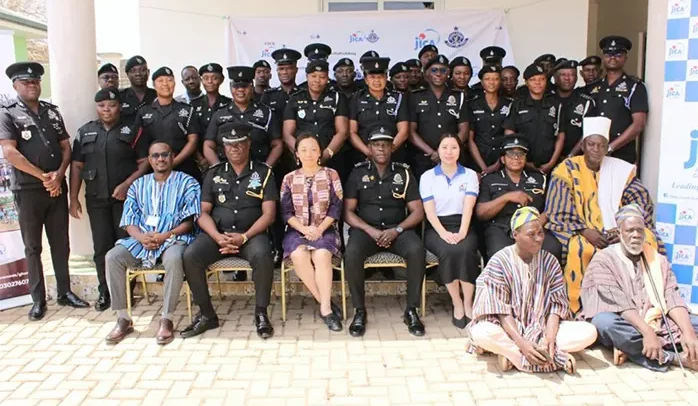

JICA officials with Police officers and stakeholders in Tamale
The Japan International Cooperation Agency (JICA), has organised the JICA In-Country Training Programme for selected police officers on Community Policing, a Training of Trainers (ToT) initiative aimed at strengthening Enhanced Community Policing Mechanisms within the Ghana Police Service.
The training seeks to build the capacity of selected police officers to promote trust, collaboration, and effective engagement between the police and communities across five (5) regions in Northern Ghana.
The officers are expected to be equipped with practical skills, knowledge, and tools to improve police-community relations and contribute to safer and more inclusive communities.
Country Representative of the Japan International Cooperation Agency, Momoko Suzuki, indicated that Ghana has long been recognised for its stability and democratic values, but the evolving security challenges in the Northern regions and the broader Sahel sub-region call for innovative and community centred approaches to policing.
“Just last week, we were reminded of the proximity of these threats by the tragic attack on Ghanaian tomato traders in Burkina Faso, an incident that signals how close these dangers are to Ghana’s borders and communities and, therefore, community policing offers strategic response by emphasising trust building, proactive engagement and collaboration between the police and the communities they serve,” she said.
According to her, the training programme marks JICA’s support to advancing community policing in Ghana, adding that JICA over the years has supported agricultural development, improving rice productivity, strengthening vegetable value chains as well as improvement of essential health systems in the Northern regions.
“Economic and social development cannot flourish without peace and stability. Northern Ghana today faces increasing pressures including the southward spillover of violent extremism from the Sahel and internal tensions such as chieftaincy-related disputes. These issues pose real risks not only to community safety but also to regional development,” she indicated.
She noted that JICA seeks to strengthen community policing as a mechanism to deepen trust between residents and the police, to ensure that both sides work together to safeguard communities across Northern Ghana.
Madam Suzuki reaffirmed that JICA intends to support community policing in Ghana over the next three years, working closely with the Ghana Police and other key stakeholders.
The Northern Regional Police Commander, DCOP Mr. Wisdom Lavoe, said modern policing goes beyond enforcement, stressing that it requires partnership, empathy and the ability to work closely with citizens to prevent crime and promote peace. He added that the training will therefore enhance their operational effectiveness across the five regions of the North.
“I wish to express our profound appreciation to JICA for their continuous support to the Ghana Police Service. Your commitment to capacity building and knowledge sharing has contributed immensely to professional policing and institutional development within our service,” he pointed out.
He urged the selected officers to be ambassadors of community-oriented policing.
“You have been chosen not only because of your competence but also because of the trust reposed in you to become ambassadors of community-oriented policing. The knowledge you acquire here must translate into practical impact within your respective commands,” he advised.
Director General, National Patrol Department, Ghana Police Service, COP Mohammed Fuseini Suraj, stated that the Inspector General of Police attaches great importance to the community policing concept, adding that “policing must not be distant or reactive, it must be proactive, accessible and rooted within the communities themselves.”
“You are not only participants, you are change agents. The effort you invest in this training will directly influence the quality of policing in your jurisdictions,” he told the selected officers.
FROM Eric Kombat, Tamale
Read Full Story




Facebook
Twitter
Pinterest
Instagram
Google+
YouTube
LinkedIn
RSS