Kokorbra (Ash), Nov 21, GNA – The government has received high marks from the chiefs of Kokorbra and Krapa in the Ejisu-Juaben Municipality for bringing development to their people. Nana Kwaku Bosompem II, Chief of Kokorbra, and his Krapa counterpart, Nana Owusu Afriyie, said they were impressed by the sustained efforts at improving the lives of the people. This was at separate ceremonies to mark the start of construction works on “sanitation village projects” in the two communities. These come with the construction of washrooms, sinking of boreholes and provision of refuse containers at a total cost of GH¢136,500.00. The facilities are expected to be ready in 10 months. The funding is coming from the International Development Agency of the World Bank. Mr Kwaku Afrifa Yamoah-Ponko, the Municipal Chief Executive (MCE), said on completion, it would help to significantly improve sanitation in those areas. GNA...
Juaso (Ash), Nov 21, GNA - Mr. De-graft Fokuo, the National Democratic Congress (NDC) parliamentary candidate for Asante-Akim South, has urged members and supporters of the party to avoid complacency and work hard to ensure resounding victory on December 7. They should continue to loudly tell the success story of the government within the last four years to woo more voters. Mr Fokuo, who is also the District Chief Executive for the area, was inaugurating an NDC youth wing at Juaso. He urged clean and decent electioneering campaign devoid of diatribe and calumny. He said it was important for all to be mindful of the peace, unity and harmony of the society as they struggled for political power and no account should they allow political differences to divide the people and tear the nation apart. Mr Fokuo invited his colleague politicians to denounce violence and acts of provocation likely to trigger needless clashes. He said through the Local Enterprises and Skills Development Programme (LESDEP), Youth in Agriculture Project and other interventions, thousands of jobs had been provided to the youth across the country and more programmes would be rolled out to create employment opportunities. Mr. Alex Ohemeng, the Constituency Chairman, said they had laid a solid foundation for the nation’s socio-economic progress and should be given another mandate to continue with their development agenda. He labelled the free senior high school (SHS) promise by the opposition New Patriotic Party (NPP) as a mere campaign tool to deceive voters and called for its rejection. GNA...
Ajumako (C/R), Nov. 21, GNA – The Ajumako-Enyan-Essiam District office of the National Commission for Civic Education (NCCE) has organised a debate among the five parliamentary candidates in the district. It is aimed at creating awareness all over on the need to maintain peace during and after the election especially among the political parties, their followers and the electorate. The aspirants weree Mr C. Ato Forson, 34, the incumbent MP for National Democratic Congress (NDC), Mr Leo Yakubu Essel Dadzie, 43, for Convention Peoples Party (CPP) and Mr Jerry Henry Quansah, 42 for Progressive Peoples Party (PPP). Mr Festus Beedu Turkson, 42, of the NPP did not attend. The moderators, Mr Kojo Owusu-Koranteng of University of Education – Winneba, Ajumako Campus and Rev Fr John Evans Arhin, a Catholic priest at Breman-Essiam led the aspirants to debate on education, employment, women and children, agriculture, roads and corruption. In attendance were chiefs from the five paramountcies in the district, representatives of all political parties, students, stakeholders in Election 2012 including Mr Fiifi Caiquo, the District Electoral Officer and his team as well as Central Region Director of the NCCE, Mr Cletus Abang. The candidates pledged that they would never engage or cause their supporters to be engaged in activities that would ignite or bring chaos, confusion and mayhem. The District Director of the NCCE, Mr Dramani Sam, said Ghana conducted peaceful, free, fair and transparent elections five times and urged all and sundry to make the upcoming sixth election peaceful and successful on December 7. GNA...
Wa, Nov. 21, GNA – Mr. Haruna Husheini Sulemana , the Upper West Regional Director of the National Commission for Civic Education (NCCE), has cautioned voters in the region to assess the issues brought up by political parties before casting their ballots in December. He appealed to voters not to sell their votes to political parties because this would amount to selling their conscience and enslaving themselves to politicians. “Political parties should be like women selling commodities in the market in which each one of them usually adopts strategies to grab the attention of buyers to enable them to sell,” he said. Mr. Sulemana said this at a day’s workshop organized by the NCCE in Wa for youth activists of political parties in the region. The workshop which was sponsored by the European Union was under the theme “Empowering the Youth to Stand for Ghana for a Peaceful Election 2012”. Participant were drawn from the NDC, NPP, CPP, PNC , PPP and some youth from the National Youth Authority. Mr. Augustine Dzineku, a member of the NCCE in charge of the three northern regions, said studies had shown that political party youth activists were often the perpetrators of electoral violence. He said most of them acted out of ignorance of regulations governing elections. Mr. Ali Adamu Osman, Wa Municipal Director of the Electoral Commission, said the commission was putting all necessary measures in place to ensure free and fair elections in December. He took participants through the biometric registration and verification process. Superintendent of Police Henry Amankwaatia took the participants through the Public Order Act and urged all to be law abiding to ensure a peaceful election. GNA...
Nkroanza (B/A), Nov. 21, GNA – President John Dramani Mahama has advised eligible voters and supporters of the NDC to spend time to educate newly registered voters of the party on the right procedure to cast their votes to reduce spoilt ballot papers on December 7. He said the NDC was poised to win Election 2012 therefore there was the need for the members to vote massively and perfectly for a resounding victory adding “The victory of the party on December 7, will be one touch”. President Mahama said this when addressing activists and supporters of the party at Nkoranza during a campaign tour of the Brong-Ahafo Region. He said with the exception of the NPP that would not appreciate the good works of the ruling NDC government, the electorate who had benefited from the many development projects in the country would vote to retain the NDC in power on December 7. President Mahama said the provision of education, health, water and sanitation facilities as well as the extension of electricity across the country bore testimony for Ghanaians to vote for the NDC in appreciation. He appealed to the electorate at Nkoranza to vote for NDC presidential candidate and two parliamentary candidates in the area in order that together, they would move Nkoranza forward. The parliamentary candidates are Mr Emmanuel Kwadwo Agyekum for Nkoranza South and Mr Kwadwo Agyei-Dwomor for Nkoranza North. President Mahama said the next NDC government would rehabilitate the Nkoranza-Jema-Nkwanta road to facilitate the movement of people and goods. “The Nkoranza town roads would also be rehabilitated by the next NDC government,” he added. GNA...
Sunyani, Nov. 21, GNA – Mr Naoto Nikai, the Japanese Ambassador in Ghana, has appealed to small scale enterprises in the country to access Japanese grants to expand their businesses. He said it was unfortunate that small business entrepreneurs had failed to take advantage of the opportunity to access the “Japanese grassroots grant assistance” being implemented at the Japanese Embassy in Accra. Mr Nikai said this during a courtesy call on Mr Kwadwo Nyamekye-Marfo, the Brong-Ahafo Regional Minister in Sunyani. He said the grant had accumulated millions of dollars as the Japanese Government continued to provide more funds to support small scale businesses. Mr Nikai said this assistance and other projects being implemented at the Embassy were efforts by Japan to support Ghana to attain her Millennium Development Goals (MDGs) in all sectors. He said the Embassy was undertaking a rural electrification project in the Techiman Municipality to connect deprived communities onto the national electricity grid. He said four Japanese volunteers were in the Brong-Ahafo Region working to help prevent contagious diseases in deprived communities. Mr Nyamekye-Marfo commended Japan for her assistance in the development of the Region, especially the water supply project Japan undertook in the Sunyani West District which enabled more than 22,000 residents to access potable water. He said the 1,300 dollars Japanese Women Training Institute at Dormaa-Ahenkro had empowered many women to be self-reliant and appealed to Japan to consider drilling more boreholes in the Region to meet the increasing demand for water. GNA...
Atebubu (B/A), Nov. 21, GNA – The Parent-Teacher Association (PTA) of Atebubu Senior High School in Brong-Ahafo Region has planned to execute projects for the educational institution. These would include the building of fence wall, kitchen and renovation of the dinning hall and library. Mr Gyan Yeboah, PTA Chairman, who announced these at a meeting, organised by the group at Atebubu, said each member was expected to pay GHc30 towards the projects. He said the PTA would provide a generator to solve the intermittent power outages facing the school, to improve teaching and learning. Mr Yeboah commended Madam Sophia Adalingeah, headmistress, and the staff for working hard to improve teaching and learning . Madam Adalingeah commended the PTA for their contribution to the development of the school. She also praised the Board of Governors of the School and the Atebubu-Amantin District Assembly for supporting the launch of an Excellence Award Day for the school to honour hardworking staff annually. Madam Adalingeah said the award had motivated the staff to work harder to towards the development of the school. GNA...
Obuasi, Nov. 21, GNA - The Flagbearer of the Progressive People’s Party (PPP), Dr Paa Kwesi Nduom will win the December presidential elections hands down and offer confidence to the country’s democracy, Mr. Abubakar Sadick Iddris, PPP parliamentary candidate for Obuasi West has predicted. “The party has people- centered and development - oriented programmes and policies that can redeem the people from their present hardship and restore hope”. Speaking to the Ghana News Agency (GNA) at Obuasi, Mr. Iddris said Dr Nduom was a man of integrity against whom nobody could raise any accusation of corruption, and that he had the development of the country at heart. “He is a man of integrity, a man of honour and that is why nobody can point accusing fingers at him”, he said. The PPP parliamentary candidate pointed out that Ghanaians were tired of failed leadership and promises by the National Democratic Congress (NDC) and New Patriotic Party (NPP) and that they were looking for a change. “Ghanaians are simply tired and fed up with the two major political parties with their continued failed leadership and promises and are now looking for an alternative and that is PPP”, Mr. Iddris said. On his vision for the Obuasi West Constituency, the Parliamentary candidate said it was three-fold, namely quality education, improved sanitation and job creation. “Education will be given priority and I will work with various stakeholders to ensure that the shift system with its attendant truancy is a thing of the past “, he stressed. He said he would lobby for the empowerment of the youth to acquire employable skills to enable them to become self sufficient in life. Mr. Iddris advised the electorate to vote for the PPP and also contribute to the attainment of peaceful elections during and after the polls. GNA...
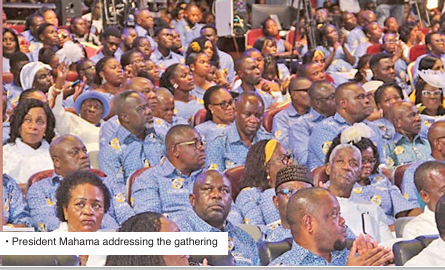
Accra, Nov. 21, GNA - President John Dramani Mahama on Wednesday called on Ghanaians to continue to pray incessantly for God’s blessings before, during and after this year’s general election in December. He said: “I know all the blessings that Ghana had received over the years is not because we are so special, but because of God’s intervention and the intercessory prayers from our men of God and of course all Ghanaians.” President Mahama made this call during a breakfast church service organized to pray for the departed souls of Ghanaians, and to also pray for peaceful elections on December 7, this year. The programme was attended by dignitaries including Mrs Georgina Theodora Wood, Chief Justice, Mrs Lordina Mahama, First Lady, Mr Henry Martey Newman, Chief of Staff, and Ministers of State. The Reverend Eastwood Anaba, Head of Fountain Gate Chapel, Archibishop Nicholas Duncan Williams, head of Christian Action Faith Chapel, Dr Lawrence Tetteh, Founder and President of the Worldwide Miracle Outreach (WMO), The Most Rev. Professor Emmanuel Asante, Chairman of the Christian Council of Ghana, Apostle General Sam Korankye Ankrah and Rev Ernest Agyei, Head of the Ringway Assemblies of God Church were also in attendance. President Mahama said there was the need for Ghanaians to pray together irrespective of their religious denominations so that God would continue to bless the country as the political icon of the African continent. He called on Muslims and Christians in the country to devote the last Friday and last Sunday prior to December 7 for special fasting and prayers in order that the general election would be peaceful and successful. He regretted the death of two illustrious sons of Ghana, late President John Evans Atta Mills and the late former Vice President Alhaji Aliu Mahama, adding ”God usually knows why he does those things and for now we have to accept it in good faith and continue praying for their souls. Recounting some moments with late President Mills, President Mahama added: “Even in the darkest of clouds President Mills still believed in God and inspired me with that faith and love of God which is keeping me strong now.” The Reverend Dr Ebenezer Markwei, who led the exhortation and prayer session said Ghana was the only country Ghanaians had, and there was the need to do everything to sustain the peace and unity that had prevailed over the years. He denounced the use of foul language in political discourse, adding that “This country has over the years enjoyed peace and unity which should be sustained and not to be taken for granted, because God has always been with us.” Dr Lawrence Tetteh appealed to all Christians and other stakeholders to keep praying and educating the Ghanaian electorate to vote peacefully to maintain the respect that other countries had shown over the years for the country’s democracy. He said even with the death of two prominent persons in the country within the same year, God would replace them with more prominent personalities in the coming years and urged Ghanaians to stand firm in their prayers to receive those blessings. The Most Rev. Emmanuel Asante said the nation could only enjoy peace and unity if the people respected each other's opinions. GNA ...
Accra, Nov 21, GNA - Mrs. Doris Gyedu-Nuako, Deputy National Coordinator of the Early Childhood Development Unit of the Ghana Education Service, says to enhance accelerated development in the country, mathematics was needed as a basis. "If so, the right training of our young children in their early years is very crucial to the future development of our country." Mrs. Gyedu-Nuako said this, at the launch of the National I-Maths program in Accra on Tuesday. I-Maths is a mathematics program for young children, which is designed according to the pattern, of how children learn to understand mathematical concepts. Through I-Maths, children learn to understand their world in terms of numbers and shapes, and to connect ideas to reason and think logically. She said it was often difficult for most children in school to learn and apply the basic rudiments of mathematics. "The teaching of mathematics in the early days of schooling may be neglecting the training for creative thinking, reasoning and problem solving skills, that are required for the comprehension of mathematical principles." Mrs. Gyedu-Nuako said the current methods of teaching mathematics only geared students towards mechanical or straight forward calculation techniques. She said I-Maths provided a teaching method which emphasized the training for creative thinking and problem solving skills, "rather than the mechanical training mentioned earlier". Mrs. Gyedu-Nuako urged parents and teachers to be patient with weaknesses which children show while they learn. "When a child gives a wrong answer while learning, do not insult or make the child feel bad. A child cannot be as intelligent as you the adult. You need to go the extra mile to understand children and help them enjoy the learning process." Prof. Dr. Dino Wong, Founder and Chairman of Universal Concept Mental Arithmetic System(UCMAS), initiators of the program, who launched the program, said mathematics should be taught in a simple but concise way, "where the learning of mathematics is a subject to look forward to and not a phobia". He said a group of mathematicians were made to study and design a complete mathematics program and after years of research, came up with the I-Maths young Children Creative Mathematics Program. Prof. Wong said the I-Maths content included various exercises that enhanced the ability of the child to think, observe, focus and solve problems from different directions. He said countries that were known for being good in mathematics, such as China, Singapore and India had all embraced I-Maths. "I will give my full support to ensure that all the aims of this program are met," said Prof Wong. An educational group and a partner in the educational system in Ghana, UCMAS Ghana Limited, has been carrying out research in the area of providing a complete training program for children of three to six years, in terms of all thinking skills and analysing techniques, required by the principles of mathematics. I-Maths, a young children's creative mathematics program, is currently one of the most influential courses being promoted in Ghana by UCMAS Ghana Limited. NEco press release Developing countries to receive over 400 billion dollars in remittances in 2012 -World Bank report. Accra, Nov. 21, GNA - A new World Bank report on global migration and remittances says remittance flows to the developing world are expected to exceed earlier estimates and total 406 billion dollars this year, an increase of 6.5 per cent over the previous year. This was contained in a press release by the World Bank made available to the Ghana News Agency on Wednesday. According to the World Bank’s press statement remittances to developing countries are projected to grow by 7.9 per cent in 2013, 10.1 per cent in 2014 and 10.7 per cent in 2015 to reach 534 billion dollars in 2015. It said worldwide remittances, including those to high-income countries, were expected to total 534 billion dollars in 2012, and projected to grow to 685 billion dollars in 2015. The release, however, said despite the growth in remittance flows to developing countries, the continuing global economic crisis was dampening remittance flows to some regions, with Europe and Central Asia and Sub-Saharan Africa especially affected, while South Asia and the Middle East and North Africa (MENA) were expected to fare much better than previously estimated. It stated that the top recipients of officially recorded remittances for 2012 were India (70 billion dollars), China (66 billion dollars), the Philippines and Mexico (24 billion dollars each), and Nigeria (21 billion dollars). Other large recipients include Egypt, Pakistan, Bangladesh, Vietnam, and Lebanon. The statement said as a percentage of Gross Domestic Product, the top recipients of remittances in 2011, were Tajikistan (47 per cent), Liberia (31 per cent), Kyrgyz Republic (29 per cent), Lesotho (27 per cent), Moldova (23 per cent), Nepal (22 per cent), and Samoa (21 per cent). The release cited Hans Timmer, Director of the Bank’s Development Prospects Group as saying: “Although migrant workers are, to a large extent, adversely affected by the slow growth in the global economy, remittance volumes have remained remarkably resilient, providing a vital lifeline to not only poor families but a steady and reliable source of foreign currency in many poor remittances recipient countries.” It said regions and countries with large numbers of migrants in oil exporting countries continued to see robust growth in inward remittance flows, compared with those whose migrant workers were largely concentrated in the advanced economies, especially Western Europe. The Bank explained that South Asia, MENA and East Asia and the Pacific regions, with large numbers of workers in the Gulf Cooperation Council (GCC) countries, were seeing better-than-expected growth in remittances. If further stated that for South Asia, remittances in 2012 were expected to total 109 billion dollars, an increase of 12.5 per cent over 2011; East Asia and Pacific region, were estimated to attract 114 billion dollars, an increase of 7.2 per cent over 2011; while MENA is expected to receive 47 billion dollars, an increase of 8.4 per cent over the previous year. According to the statement, remittances to Latin America and the Caribbean were supported by a recovering economy and an improving labor market in the United States but moderated by a weak European economy. It noted that the region would see a modest growth of 2.9 percent in 2012, totaling an estimated 64 billion dollars. “In contrast, remittances are expected to remain flat to Europe and Central Asia and Sub-Saharan Africa regions, mainly because of the economic contractions in high-income European countries. Remittance flows to Europe and Central Asia are estimated at a virtually unchanged 41 billion dollars and 31 billion dollars to Sub-Saharan Africa this year, although both regions are projected to make a robust recovery in remittance flows in 2013,” the World Bank said. The release quoted Dilip Ratha, Manager of the Bank’s Migration and Remittances Unit, and lead author of the Migration and Development Brief as saying: “Migrant workers are displaying tremendous resilience in the face of the continuing economic crisis in advanced countries. Their agility in finding alternate employment and cutting down on personal expenses has prevented large scale return to their home countries.” It said going forward, the Bank expected continued growth in remittance flows to all regions of the world, although persistent unemployment in Europe and hardening attitudes towards migrant workers in some places present serious downside risks. It said another obstacle to growth of remittance flows was the high cost of sending money, which averaged 7.5 per cent in the third quarter of 2012 for the top 20 bilateral remittance corridors and 9 percent for all countries for which cost data are available. “The average remittance cost for Sub-Saharan Africa was 12.4 per cent, the highest amongst all developing regions,” the Bank added. It stated that the Migration and Development Brief also indicated that the promise of mobile remittances had yet to be fulfilled, despite the skyrocketing use of mobile telephones throughout the developing world. It said mobile remittances fall in the regulatory void between financial and telecom regulations, with many central banks prohibiting non-bank entities to conduct financial services. It said Central banks and telecommunication authorities need to come together to craft rules relating to mobile remittances. The release also said the report cited the implementation of the new remittance regulations in the United States and Europe and concluded that those regulations were likely to lower remittance costs in the long run by increasing competition and improving consumer protection. “The global community has made progress in three out of four areas of the global remittances agenda – data, remittance costs, and leveraging remittances for capital market access for countries. Progress, however, has been slow in the area of linking remittances to financial access for the poor. There is great potential for developing remittance-linked micro-saving and micro-insurance schemes and for small and medium enterprise (SME) financing,” it said. The release stated that as a key player in the migration and remittances arena, the World Bank is working on a new initiative, the Global Knowledge Partnership on Migration and Development (KNOMAD), which aimed at facilitating multidisciplinary debate and discussion on migration issues, developing policy options, and assisting sending and receiving countries implement pilot policies. It said the Bank also continued to make considerable strides in developing financing instruments for leveraging migration and remittances for national development purposes. “Diaspora bonds can be a powerful financial instrument for mobilizing diaspora savings to finance specific public and private sector projects, as well as to help improve the debt profile of the destination country. The Bank has also set up a Diaspora Bond Task Force to provide technical assistance to countries interested in implementing diaspora bonds for financing development projects,” the release stated. GNA...

Princess town (W/R), Nov. 21, GNA – Soroma Capital Limited, a real estate investment and development group, has cut the sod for work to begin on a five star luxury hotel in the Ahanta West District of the Western Region. The 150-room hotel, which will include a recycling plant, would use locally sourced materials in its construction to ensure that it meets internationally acceptable standards. The eco-chic hotel would also minimize its carbon footprint by adopting a wide range of sustainable features including low energy consumption facilities, the creation of a wildlife sanctuary and initiate a turtle breeding program. Dr Ayowa Afrifa Taylor, Managing Director of Soroma Capital, said studies in 2006 revealed that Ghana’s tourism sector was growing faster than other sectors of the economy and that situating the hotel at Princess Town was based on the recommendation of the Ministry of Tourism which suggested available areas suitable for resort development. She said social sustainability was at the forefront of the project and to assist the hotel meet its objectives, a social-economic survey to measure the demographic characteristics of the area was undertaken by the Department of Geography and Tourism, University of Cape Coast. She said the design of the hotel also seeks to promote the interrelatedness of the surrounding towns saying “the hotel is not walled enclave but an integrated part of the local community with walking routes across the beach and the lagoon”. Mr Joseph Donfoyenah, District Chief Executive of Ahanta West, on behalf of the Regional Minister, said the construction of the hotel would bring employment to the people of the area and help reduce poverty. He said when completed, the hotel’s conferencing facility could serve as a vital infrastructure supporting industries in the Western Region saying “it’s a wonder why Accra hosts most of the mining and oil and gas conferences when these industries are based in the Region.” Mr Donfoyenah said government deserves to be commended for its investment policies, the current peace and stability being enjoyed, and for creating an enabling environment for investments. He also commended the people, chiefs and the royal family of Princess Town for agreeing to put aside their differences and see to the development of the resort. Present at the ceremony were Mr Samuel Johnfiah, Member of Parliament of Ahanta West, representatives of Glico Group, Ghana Tourism Authority, Ghana Wildlife Society, Town and Country Planning and Chiefs and people of Princess Town. GNA ...
Accra, Nov. 21, GNA - President John Dramani Mahama has stated that government had embarked on a number of measures geared towards combating crime in the coming years. He mentioned the recruitment of 4000 policemen and women, establishment and equipment of a forensic laboratory among others as some of the measures government had embarked on to eliminate the menace. President Mahama stated this when he participated in the second Institute of economic Affairs (IEA) Presidential Debate held in Accra on Wednesday. The debate is the second in the series organized for four Presidential candidates that have representation in Parliament. Other participants in the debate are: Nana Addo Dankwa Akuffo-Addo, Presidential candidate of the New Patriotic Party, Dr Forster Abu Sakara, Presidential candidate of the Convention People’s Party and Mr Hassan Ayariga, Presidential candidate for the People’s National Convention. The first Presidential debate was held in Tamale last October and was followed by a Vice Presidential candidate debate earlier this month. President Mahama said government would strengthen the forensic laboratory for the testing of ballistic, narcotic drugs and DNA, while the Narcotic Board would be supported to step up detection and arresting as an effective way of preventing crime. On corruption, President Mahama appealed to Ghanaians to be bold to point out and report people suspected to have been engaged in one corrupt practice or the other for the appropriate authorities to take action. The president gave the assurance that he would be more than willing to sign the freedom of information bill into law as soon as it got into his domain adding that the bill was still in Parliament and was yet to get to him. He promised to exhibit leadership by example, by staying clean of corruption and by ensuring that his Ministers and others at the Presidency lived above reproach in the political society. On decentralization, President Mahama promised to increase budgetary allocation to the Commission on Human Rights and Administrative Justice and Economic and Organised Crime Organisation to live up to the expectation of fight crime and corruption in society. He said the same agencies would also be strengthened to ensure that the National Anti-Corruption plan worked perfectly and effectively in the country. President Mahama said the introduction of composite budget by the National Democratic Congress government was in response to the inadequacies at the district levels, and such budgets could take care of the health and education sectors that were important in the growth and development of the country. He promised to pursue the election of Metropolitan, Municipal and District Chief Executives to ensure that they were more accountable to the people they served. GNA ...
Accra, Nov. 21, GNA - The Ghana Interbank Payment and Settlement System (GhIPSS) on Wednesday launched the ‘gh-link’, an interbank switching and processing system that would enable Ghanaian banks to share each other’s Automated Teller Machines (ATM). The gh-link will interconnect the switches of financial institutions and systems of third party institutions to enable them utilize a common platform for interbank transactions in an effective and efficient manner. Mr Archie Hesse, Chief Executive Officer of GhIPSS, said the 'gh-link' can be used to provide varied electronic services, however, as a first step the interbank ATM Transaction Switching was being launched to allow local card holders to withdraw cash from any ATM outlet. So far, 13 banks have reconfigured their systems and can now accept each other’s ATM cards and this means customers of these banks can gain access their bank accounts and make withdrawals from the ATMs of any of these nine banks. The banks, which include major financial institutions, are Ghana Commercial Bank, Standard Chartered Bank, Agriculture Development Bank and Zenith Bank. Others are HFC Bank, United Bank for Africa (UBA), Ut Bank, Prudential Bank, and the Bank of Africa. The rest are Unibank, Guaranty Trust Bank, Stanbic Bank and Ecobank. Access Bank is expected to be on board by the time the service is launched. “We strongly anticipate that all banks will be on board by next year,” Mr Hesse said adding that efforts were also being made to sign on Visa and MasterCards so that the service would be completely universal in the country. He urged the general public to patronize the various services available saying local cards could in future be used to shop whiles plans were underway to interconnect with other switches in the sub-region. Mr Hesse asked the banks to be innovative and take advantage of the opportunities to make banking more appealing to the public. Mr Millison Narh, Deputy Governor Bank of Ghana, said the launch of the 'gh-link' marked another milestone in the development of the payments and settlement systems that would help meet the long-term objective of financial inclusion and make the country a cashless society. He said the e-zwich platform provided opportunities for effective mobilization and intermediation of financial resources and also extended the financial services to daily transactions. GhIPSS has since 2008 led the reform of the country’s payment systems, acquired the National Electronic Platform to enable all banks to interconnect and ensure that Ghana moves away from the era when customers had to travel long distances to access their money from an ATM. GNA ...
Accra, Nov. 21, GNA – The second Institute of Economic Affairs (IEA) presidential debate for candidates of political parties with representation in parliament is underway at the Banquet Hall of the State House. Security arrangements are tight as dignitaries were thoroughly searched before taking their seats. Senior officials of the parties, ministers of state, diplomats, traditional rulers and the clergy are among those present at the debate at the Banquet Hall decorated in national colours of red, yellow and green. Traditional horn blowers ushered in the four candidates – President John Dramani Mahama of the National Democratic Congress (NDC), Dr Abu Sakara Foster of the Convention People’s Party (CPP), Mr Hassan Ayariga of the People’s National Convention (PNC) and Nana Akufo-Addo of the New Patriotic Party (NPP). A minute’s silence was observed in memory of the late former vice president Alhaji Aliu Mahama who passed away last week. GNA ...
Hohoe, Nov 21, GNA-A new global report on HIV and AIDS spotlights success in both prevention and treatment efforts, but also stresses that countries must ramp up both if the world hopes to meet the ambitious goals agreed upon last year at a special session of the United Nations. The report, released Tuesday by the Joint United Nations Programme on HIV/AIDS (UNAIDS), estimates that the world had 34 million HIV-infected people at the end of 2011. The most heartening news is that the rate of new infections, 2.5 million people last year, represents a 20% drop from 2001. The decline has been greater than 50% in 25 low- and middle-income countries, including some of the hardest hit in sub-Saharan Africa. Roughly one-half of the decline is the result of interventions that aim to prevent transmission of HIV from pregnant women to their babies. "It's amazing what's happening," UNAIDS Executive Director Michel Sidibé said in remarks and made available to the GNA. "We're increasing the pace of action. What was taking 10 years now is taking 2 years, even with the same level of resources." Similarly impressive gains have occurred with treatment. Antiretroviral (ARV) drugs are now provided to 8 million people, a 20-fold jump since 2003. AIDS-related deaths have also fallen to 1.7 million, down from 2.3 million in 2005. The report, which UNAIDS issued on the eve of World AIDS Day (December 1, 2011) describes this news as "encouraging," but also squarely acknowledges the daunting challenge of hitting several of the 2015 targets set at the United Nations meeting. Specifically, countries agreed that three years from now, they will be providing 15 million people with ARVs, slash sexual and injecting drug transmission by 50%, and eliminate mother-to-child transmission. "The next thousand days will be a real test to our collective commitment and action," said UNAIDS official Bernhard Schwartländer at a teleconference on Tuesday. GNA...
Agona Nsaba, Nov 21, GNA -The Centre for Democratic Development, Ghana, (CDD), has expressed concern about the politics of intolerance and insults as the Election 2012 approaches and said this had to stop. Mr Edward Fokouh Ampratwum, National Research Officer of CDD, said this at a parliamentary debate at Agona Nsaba to discuss issues affecting people with disability, women and unemployed Youth. It was organized by CDD-Ghana, Coalition of Domestic Elections Observers (CODEO) and Open Society Initiative for West Africa (OSIWA). Parliamentary candidates of the National Democratic Party (NDP), Progressive Peoples Party (PPP) and an independent candidate attended for debate. Madam Pokuah Sawyer, National Democratic Congress (NDC) parliamentary candidate for the area, could not attend because according to her, she had a funeral. Mr John Kwesi Agyabeng, the NPP parliamentary candidate and the MP for the area, also failed to turn up. Mr Ampratwum expressed regret that there had been mistrust, intimidation and suspicion among political opponents and this would not help the growth of the country’s democracy. Mrs Esther Aboagye, PPP parliamentary candidate, urged the electorate to vote for her and Dr Paa Kwesi Nduom, the PPP presidential candidate. Mr Magnus Abban, NDP parliamentary candidate, said the people of Agona East needed aggressive development projects and he would do it and Mr Musah Bashiru, the independent candidate, appealed to the people to vote for him since the NDC had failed to provide basic social amenities in the Agona District. GNA...
Accra, Nov. 20, GNA – The Government has stated that after an objective comparative analysis of the manifestos of the National Democratic Congress (NDC) New Patriotic party (NPP) it becomes crystal clear that the ruling party has a superior and a more comprehensive agenda for Ghanaians. This coupled with the NDC’s “unprecedented performance” in government explained why the Ghanaian electorate would place the future of Ghana in the hands of President John Mahama of the NDC, an official statement. The statement signed by Deputy Minister of Information, Mr. Samuel Okudzeto Ablakwa, explained that the comparative analysis of the two manifestos was carried out in order to enrich the debate on the alternatives on offer to the Ghanaian electorate and also to deepen discussion on substantive issues of germane importance to the Ghanaian. Mr. Okudzeto Ablakwa added that it could not be said that the two leading political parties were offering the same package to the electorate. “This analysis reveals that there are clear distinctions and approaches which form the fundamental basis for the choice of the electorate and not the parochial sectarian divisions which opponents of President Mahama are trying hard albeit without success to create.” Mr. Okudzeto Ablakwa said that the comparative analysis, which showed the NDC as the party with great original ideas and also possessing the ability to proffer pragmatic solutions and offer hope for the future, further confirmed the NDC as the obvious choice in this election. The following is the full text of key conclusions in the comparative analysis. " 1) “The NPP Manifesto under its health agenda totally neglects traditional medicine unlike the NDC manifesto which has a clear programme for traditional medicine including supporting the establishment of the proposed School of Traditional Medicine at the University of Health and Allied Sciences. 2) The NPP Manifesto ignores equity and makes no provision for Regional Hospitals unlike the NDC Manifesto which pledges to establish regional hospitals in the Eastern Region, Upper East Region and complete what has been started by the NDC in the Upper West Region. This is aside several other district hospitals and polyclinics the NDC promises. Though the NPP promises to seek assistance from the private sector to establish three first class hospitals in their manifesto, they make no commitments to the people of Ghana as to where they will be sited and what will happen if they fail to get the private sector support they are relying on. 3) Whereas the NDC Manifesto speaks to doubling the number of Community Health Improvement Planning and Service (CHPS) Compounds from 1600 to 3,200 given that over 1,300 have been constructed over the last four years, the NPP Manifesto is silent on CHPS as well. 4) The NPP Manifesto has no intervention for the National Ambulance Service neither do they make provision for the establishment of an Accident Evacuation Centre to save lives on our major highways like the NDC does in its Manifesto. 5) The NPP has no plan to upgrade the Central and Volta Regional Hospitals into Teaching Hospitals to service the University of Cape Coast and the University of Health and Allied Sciences respectively as contained in the NDC Manifesto. 6) After seeing to the collapse of Ghana Airways, the NPP makes no provision to restore our national pride. To the contrary, the NDC Manifesto boldly makes a case for the re-emergence of a national carrier. 7) The NPP manifesto makes no provision for a Youth Jobs and Entrepreneurs Development Fund for young entrepreneurs to have easy access to start-up capital but the NDC Manifesto does. 8) The NPP manifesto outlines no programme to stimulate the private sector in order that the private sector is able to employ more Ghanaian youth as compared to the NDC Manifesto which makes a clear provision for a stimulus package. 9) The NPP manifesto makes no provision to enhance the capacity and welfare of Ghanaian Media practitioners in its Manifesto unlike the NDC Manifesto which makes extensive provision for the welfare and capacity of the Media and the National Media Commission including the commitment to complete a permanent campus for the Ghana Institute of Journalism at Okponglo in Accra. 10) The NPP Manifesto makes no provision for National Reconciliation and harmonious coexistence unlike the NDC Manifesto which provides for a framework for national reconciliation including President John Mahama’s initiative to institute a quarterly meeting with all political party leaders. 11) The NPP Manifesto makes no provision for universal access to Energy. Only the NDC Manifesto pledges Energy for all by 2016. 12) No programme in the NPP Manifesto to flush out foreigners who have invaded the small-scale mining sector since the sector is strictly reserved for Ghanaians like the NDC Manifesto does. 13) No talk of a National Science Park in the NPP Manifesto whereas the NDC Manifesto pledges to construct 2 National Science Parks to spread the benefits of technology across Ghana. 14) NPP Manifesto places no emphasis on early childhood and pre-kindergarten education considered very essential as the NDC Manifesto does. 15) NPP manifesto says nothing about expanding the school feeding programme to achieve universal coverage unlike the NDC Manifesto which acknowledges the expansion in coverage from 600,000 children to over 1.4 million children over the last four years, the NDC Government commits to universal coverage to cover all public schools in rural and needy communities. 16) NPP Manifesto says nothing about the Shift system the current government is seeking to abolish nationwide having succeeded in Accra unlike the NDC Manifesto 17) No mention of regular reviews of the Capitation Grant as the NDC states in its Manifesto 18) No attempt to address the many hidden costs at the basic level which has hampered free basic education as the NDC proposes to do 19) No attempt to address universal access at the Senior High School level. The NDC Manifesto pledges to achieve this by 2016 20) NPP provides no specifics on expansion of new Senior High Schools to address the problem of access unlike the NDC which pledges to establish 200 Community Day Senior High Schools. 21) Unlike the NDC manifesto which pledges to provide facilities in existing schools for students with disability, the NPP manifesto is silent on making our schools disability friendly. 22) The NPP Manifesto seems to have no clear solution at addressing the acute teacher deficit unlike the NDC Manifesto which pledges to establish 10 additional Teacher Training Colleges. 23) No special incentives for teachers in terms of incremental credits for Science, Technical and Vocational Teachers as the NDC manifesto provides. 24) The NPP manifesto appears to ignore strategic tertiary institutions such as the Teacher Training Colleges, the National Film and Television Institute (NAFTI) and the Ghana Institute of Journalism (GIJ) unlike the NDC manifesto which has specific interventions for each of these. 25) The NPP manifesto doesn’t outline any programme to provide computers for students unlike the NDC manifesto which promises 400,000 laptops for students. 26) The NPP Manifesto fails to provide laptops for teachers unlike the NDC manifesto which makes provision for free laptops for teachers.” GNA...
Kumasi, Nov. 21, GNA – Agricultural research scientists in Africa have been urged to establish stronger linkages and share ideas and expertise to tackle challenges impeding the growth of the agriculture sector. Professor Seth Kofi Akyea Danso, a member of the Ghana Academy of Arts and Sciences, said collaborative efforts through workshops and other forums were needed to address the post-harvest losses, low productivity, hunger, outmoded farming methods and low adoption rate of technology. He warned that it would be difficult to achieve food sufficiency for the continent in the wake of the changing climatic conditions and fast growing population unless the researchers accepted to pull their resources together. Prof Danso said this when addressing the opening session of a three-day regional workshop on root and tuber crops at the Crop Research Institute (CRI) at Fumesua, in the Ejisu-Juaben Municipality. The workshop is being organized jointly by the Food and Agriculture Ministry and the Council for Scientific and Industrial Research (CSIR) and “Enhancing food security and regional integration through agricultural research and development”, is its theme. Prof Danso said the roots and tubers had the potential to prevent extreme hunger and poverty, adding that they could create employment for the people through value addition. Those crops, he said, had for many years been used for varied purposes and could be grown on larger scales for both local and international consumption. He expressed discomfort with the inability of Africa to feed its own people, relying mostly on food imports saying to end this trend would require making the right investment in the sector. Dr Abdullai Baba Salifu, Director-General of the CSIR, encouraged the CRI to continue to work hard to develop improved crop varieties for local consumption. GNA ...
Accra, Nov. 21, GNA - Finatrade Foundation, a subsidiary of the Finatrade Group of Companies has released a total of GH¢ 20,000.00 as bursary to brilliant, but needy Agricultural students in four public Universities. Forty students are currently benefitting from the facility, while another 20 students would be selected for the 2012/2013 academic year by February next year. Mr John Awuni, Corporate Affairs Manager of the Finatrade Group of Companies, who disclosed this in an interview with the Ghana News Agency (GNA) said the students were drawn from the University of Ghana, Kwame Nkrumah University of Science and Technology, University of Cape Coast and the University for Development Studies. He said the Foundation some few years ago instituted the scholarship scheme to support brilliant agricultural students, who were facing financial difficulties to harness their potentials and educate other people to accept agriculture as the mainstay of the economy. Apart from the scholarship for the undergraduates, the foundation also helped the students to gain practical knowledge by establishing demonstration farms. “So far, the Foundation has established demonstration farms at the Kwame Nkrumah University of Science and Technology and the University of Ghana,” Mr Awuni added. Mr Awuni said the Foundation had also supported eight post-graduate research students in Agriculture who would make their findings available for school authorities and political leaders to implement their recommendations for the betterment of agriculture in the country. The Corporate Affairs Manager told the GNA that since the inception of the scholarship, beneficiaries had performed tremendously adding “their performance will continue to encourage us to continue to support many others. GNA ...
Accra, Nov.21, GNA – Advocacy and Trainers for Children and Women Advancement Rights (ATCWAR) in collaboration with World Children Prize (WCP) on Tuesday organized a four-day capacity building training for 120 girls from some selected schools in Accra. The training which is aimed at promoting girls to be children ambassadors brought together students from the Central, Eastern, Volta and Greater Accra Regions. The training was also to raise awareness and support children, especially girls who want to fight for their rights and against the child sex trade. Ms Ekua Ansah-Eshon, Country Director of WCP, said the event was also to provide the children and schools with a unique, fun and exciting way to learn about their rights, the lives of children all over the world and about child rights heroes who fought for the world’s vulnerable children. She said the girls will receive basic training on the rights of the child, girl’s rights, the child sex trade (commercial sexual exploitation of children), the WCP education program and how to start and run WCP Child Rights Clubs. Ms Ansah-Eshon said it was important that schools and churches in the country establish child rights clubs to inform and educate children on how to fight for their rights and also to protect other people’s rights. She said child abuse was a very big offence which needed continuous education on how to treat children at schools, churches, in our homes and in our everyday life in our societies and communities and also fight against the child sex trade. Mr Kofi Kumah, National Coordinator of Ghana NGO’s Coalition on the Rights of the Child (GNCRC), said the knowledge of children needs to be deepened on the country’s laws, especially laws that fight for children’s rights. The called on parents and guardians to educate them on prostitution, sexual harassment, divorce, child trafficking, and corporal punishment in schools, early and force marriage and to also encourage guidance and counseling. Mr Barima Kwasi Amankwaah, Programmes Officer of GNCRC and Chairman of the occasion, appealed to organizers of the program to continue to do more and expand the programme to the other parts of the country. GNA ...
Facebook
Twitter
Pinterest
Instagram
Google+
YouTube
LinkedIn
RSS