


The Ghana Cocoa Board (Cocobod) is currently unable to pay for cocoa it has purchased from farmers due to a breakdown in its traditional financing model, accumulated debt from undelivered cocoa contracts and sharp shifts in global cocoa prices, according to the Chief Executive of Cocobod, Dr Randy Abbey.
Dr Abbey disclosed this during a meeting he held with editors in December, last year, and his recent engagements with the media. His recent remarks came days after the Minority in Parliament organised a press conference to protest the delays in payments to cocoa farmers and accused Cocobod of mismanaging the sector.
Apology to Farmers
The Chief Executive of Cocobod admitted that farmers who have delivered cocoa but have not been paid deserve an apology.
“Those who have delivered their cocoa and have not been paid definitely deserve an apology. And those who have cocoa ready to be sold but are unable to sell and even those preparing to harvest without clarity on purchases, also deserve an apology.”
He assured farmers that Cocobod and the government are engaged in discussions to resolve the situation and that efforts are underway to restore payments as soon as possible.
How Cocoa Purchasing Works
Cocobod does not buy cocoa directly from farmers but purchases are made through Licensed Buying Companies (LBCs), which are provided with funds to buy cocoa on Cocobod’s behalf at producer prices announced at the beginning of each season.
For over three decades, Cocobod financed cocoa purchases through an annual syndicated loan. Under this system, Cocobod projected expected cocoa output for a season and signed forward contracts with international buyers. These contracts were then used as collateral to secure loans from a consortium of international and local banks.
The proceeds of the syndicated loan were lodged with the Bank of Ghana, which released the cedi equivalent to Ghana Cocoa Board.
Cocobod, in turn, advanced seed funds to LBCs to purchase cocoa from farmers. This system operated for about 32 years.
Financial Distress and Cocoa Bills
According to Dr Abbey, Cocobod’s financial position deteriorated significantly in 2022, when it announced that it could no longer service its Cocoa Bills short-term debt instruments issued to raise funds from institutions and individuals.
The Cocoa Bills were subsequently restructured, resulting in haircuts for investors and a deferment of repayments.
Under the restructuring arrangement, the first repayment is due in September 2025, with funds expected to be lodged by August 2025.
Dr Randy Abbey said this development signalled to the financial market that Cocobod was in financial distress, undermining confidence in its ability to meet future obligations.
Breakdown of the Syndicated Loan
In the 2023/2024 cocoa season, Cocobod attempted to raise its annual syndicated loan under the traditional model. However, for the first time in the history of the arrangement, the loan was severely delayed.
Although the cocoa season opened in September 2023, the first tranche of the syndicated loan was not received until two days before Christmas.
Local Buying Companies (LBCs), according to Dr Abbey, did not receive funds from Cocobod until January 26, 2024.
At one point during the season, Cocobod was unable to draw further funds from the syndicated loan and had to secure a US$70 million bridge facility from the Ministry of Finance to continue purchasing cocoa.
Failure to Deliver Cocoa Contracts
At the end of the 2023/2024 season, Cocobod failed to deliver 333,767 tonnes of cocoa that it had sold forward at US$2,600 per tonne.
This marked the first time in Cocobod’s history that it was unable to supply such a significant volume of cocoa under signed contracts.
“These contracts had been used as collateral to raise financing. Failing to deliver them had serious consequences,” Dr Abbey said.
The failure to supply cocoa further damaged Cocobod’s credibility with international buyers and lenders.
Impact of Global Cocoa Price Surge
Shortly after Cocobod defaulted on the undelivered contracts, global cocoa prices surged to unprecedented levels, reaching between US$9,000 and US$12,000 per tonne before settling around US$9,000.
However, Ghana was unable to fully benefit from the price surge due to the existence of rollover contracts for undelivered cocoa sold earlier at US$2,600 per tonne, which were carried into the 2024/2025 season.

When Cocobod calculated its average Free On Board (FOB) price for the season, the rollover contracts significantly reduced the weighted average price, despite high global prices.
As a result, the declared FOB price for the 2024/2025 season was about US$4,800 per tonne, and farmers received approximately US$3,100 per tonne, representing about 63.9 per cent of the FOB. This led to widespread criticism that farmers were being underpaid despite record world market prices.
Revenue Losses
Dr Abbey said the rollover contracts resulted in an estimated revenue loss of US$941.58 million in the 2024/2025 season. “That amount could have gone to farmers and also helped reduce Cocobod’s debt,” he said.
In addition, Cocobod accumulated significant arrears to LBCs. Because LBCs paid farmers US$3,100 per tonne while the cocoa was used to settle US$2,600 rollover contracts, Cocobod owed LBCs the US$500 difference per tonne.
By the end of the season, Cocobod owed LBCs about GH¢4 billion as a result of these pricing differences.
Shift to Buyer-Funded Model
Due to its weakened financial position, Cocobod was unable to raise a syndicated loan for the 2024/2025 season. A request for proposals issued to banks received no responses.
As a stopgap measure, Cocobod adopted a buyer-funded model. Under this arrangement, international buyers financed cocoa purchases directly by paying about 60 per cent upfront, with the balance paid upon delivery. Cocobod then passed the upfront funds to LBCs to purchase cocoa from farmers.
Dr Abbey described this model as temporary and unsustainable, noting that it transferred financing costs to buyers and constrained Cocobod’s flexibility.
In the 2025/2026 season, the volume of rollover contracts reduced to about 98,000 tonnes, allowing Cocobod to declare a higher FOB price of US$7,200 per tonne. In line with government policy, farmers were paid 70 per cent of the FOB, equivalent to US$5,040 per tonne.
However, global cocoa prices subsequently declined sharply to around US$4,100 per tonne. Under the buyer-funded model, buyers became unwilling to purchase Ghana’s cocoa at prices significantly above prevailing market levels, especially given additional costs related to haulage, grading, warehousing and shipping.
As a result, buyers diverted purchases to other cocoa-producing countries, including Côte d’Ivoire, Nigeria, Togo, Ecuador and Brazil.

Cocobod and the Ministry of Finance according to the Cocobod CE are working on a new funding model expected to take effect from the 2026/2027 cocoa season.
The new model is intended to reduce dependence on raw bean exports, support value addition, and restore financial sustainability. Until then, Cocobod says it is engaging stakeholders to stabilise cocoa purchases and address outstanding payments.
Cocoa Taken but Not Paid For
Dr Abbey said Cocobod had already purchased and fully paid for about 530,000 tonnes of cocoa. However, an additional volume-estimated at about 50,000 tonnes-was taken over from LBCs without corresponding buyer contracts.
This, he explained, accounts for reports by some farmers that their cocoa has been taken but payment delayed. “The cocoa exists, but buyers are unwilling to take it at current prices,” he said.
Minority Protest
The Minority in Parliament on February 5, 2026 accused Cocobod of mismanagement and demanded immediate payment to farmers. The issue has intensified political pressure on the government, particularly in cocoa-growing regions.

The Minority Caucus in Parliament had rejected Cocobod’s explanation for the payment delays, accusing the government and Cocobod of mismanagement and failing to prioritise cocoa farmers.
In a statement issued after a press conference, the Minority said Licensed Buying Companies (LBCs) have been unable to pay farmers for cocoa delivered since November 2025 because Cocobod has failed to reimburse them for cocoa already taken over.
According to the Minority, Cocobod owes LBCs more than GH¢10 billion in unpaid cocoa taken-over receipts, leaving the companies financially constrained and unable to continue purchases.
The Minority argued that farmers have been forced to sell cocoa on credit, at discounted prices, or return home with unsold produce, warning that the situation poses serious risks to the cocoa industry and the wider economy.
The caucus dismissed claims that Cocobod lacks funds to pay farmers, citing government budget data indicating that cocoa export receipts amounted to about US$2.56 billion.
It also accused Cocobod of issuing misleading public statements suggesting that sufficient funds had been released to LBCs, insisting that farmers have not been paid for cocoa sold for several months.
The Minority further disputed Cocobod’s assertion that Ghana defaulted on syndicated loan repayments during the 2023/2024 cocoa season.
According to the caucus, Ghana has never defaulted on its syndicated cocoa loans since the facility was introduced in 1993, and it challenged Cocobod’s management to provide evidence of any default.
On the issue of contract rollovers, the Minority described the practice as a standard industry occurrence, noting that previous administrations inherited rollover contracts without disrupting farmer payments.
It blamed the current crisis on changes to Cocobod’s forward sales strategy, alleging that the government reduced advance cocoa sales in anticipation of sustained high prices, leaving the sector exposed when prices fell.
The Minority demanded the immediate payment of all outstanding amounts owed to cocoa farmers and LBCs, an apology from government and Cocobod, and urgent measures to stabilise cocoa purchasing and restore confidence in the sector.
Parliamentary Committee
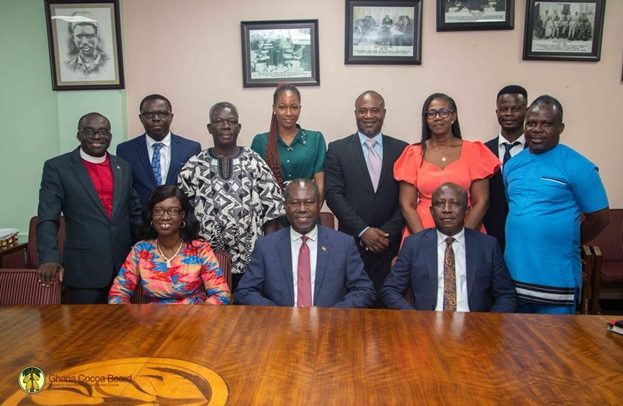
A day after the Minority Caucus issued its statement, the Parliamentary Committee on Food, Agriculture and Cocoa Affairs met with the Ghana Cocoa Board (Cocobod) on February 6 to assess the payment challenges in the cocoa sector.
The committee, led by its Chairperson, Dr. Godfred Seidu Jasaw, urged Cocobod to intensify public education and engagement with cocoa farmers and other industry stakeholders.
According to the committee, clearer and more consistent communication was needed to help stakeholders better understand the challenges confronting the sector and the measures being implemented to address them.
The committee recommended that Cocobod consider announcing a more competitive producer price to help restore buyer confidence and attract traders who have withdrawn from the Ghanaian cocoa market in recent months.
It also called for urgent reforms to the cocoa pricing system, including the possibility of partial deregulation, to be developed in collaboration with the Ministry of Finance to make cocoa trading more attractive.
In addition, the committee urged the fast-tracking of a new cocoa law that would provide a sustainable financing and pricing framework for the sector. It further encouraged Cocobod to deliberately expand local cocoa processing capacity to create a more reliable domestic market for cocoa beans.
The committee commended Cocobod for making payments to LBCs despite the ongoing challenges. According to figures presented, Cocobod paid GH¢5.48 billion in November 2025, GH¢6.45 billion in December 2025, GH¢5.33 billion in January 2026, and GH¢0.62 billion in February 2026.
However, the committee urged Cocobod to fast-track the settlement of outstanding payments owed to LBCs and to remain vigilant against reverse smuggling, noting that cocoa prices in neighbouring countries are currently lower than those in Ghana.
Farmers Express Frustration Over Unpaid Cocoa
Meanwhile the Ghana National Cocoa Farmers Association has expressed frustration over unpaid wages since November 2025.
The Association claimed its members have not been paid for cocoa supplied since last November. Speaking on a talk show in Kumasi on Tuesday, February 3, 2026, the National President of the Association, Anane Boateng, said months of delayed payments have plunged farmers into severe financial hardship, affecting their ability to meet basic needs such as school fees, feeding and healthcare.
He said that despite several appeals to the appropriate authorities, the problem has persisted for months. According to him, families whose only source of income is cocoa cultivation have suffered significantly as a result of the delays.
Mr Boateng said there has been little communication from authorities, leaving farmers uncertain about when payments will be made. “We have worked hard to produce high-quality cocoa, but we have not been paid. For us and our families, this is a really difficult situation,” he said.
He called on the government to take immediate action to resolve the crisis. “It is really affecting farmers. Some are sick and need medical care, but they do not have the money to go to the hospital,” he lamented. He warned that if Cocobod cannot effectively support the livelihoods of cocoa farmers, the institution should be restructured or scrapped.
The post Why Cocobod Can’t Pay Farmers –Randy Abbey explains appeared first on The Ghanaian Chronicle.
Read Full Story






Facebook
Twitter
Pinterest
Instagram
Google+
YouTube
LinkedIn
RSS